7069612
EEA1 Monoclonal Antibody (1G11), eBioscience™, Invitrogen™
Mouse Monoclonal Antibody
Manufacturer: Fischer Scientific
The price for this product is unavailable. Please request a quote
Antigen
EEA1
Concentration
0.5 mg/mL
Classification
Monoclonal
Form
Liquid
Regulatory Status
RUO
Formulation
PBS with 0.09% sodium azide; pH 7.2
Gene Alias
A430109M19Rik; B230358H09Rik; Early endosome antigen 1; early endosome antigen 1, 162kD; early endosome-associated protein; EEA1; Endosome-associated protein p162; MST105; MSTP105; ZFYVE2; Zinc finger FYVE domain-containing protein 2
Gene Symbols
EEA1
Primary or Secondary
Primary
Content And Storage
4° C
Gene
EEA1
Clone
1G11
Applications
ELISA, Immunocytochemistry, Immunohistochemistry (Paraffin), Western Blot
Conjugate
Unconjugated
Host Species
Mouse
Target Species
Human, Mouse, Rat
Gene Accession No.
Q15075, Q8BL66
Gene ID (Entrez)
216238, 314764, 8411
Isotype
IgG1 κ
Purification Method
Affinity chromatography
Product Type
Antibody
Related Products


Description
- Description: The monoclonal antibody 1G11 recognizes human, mouse and rat early endosome antigen 1 (EEA1)
- EEA1 is a hydrophilic peripheral membrane protein found in the cytosol and present on early endosome membranes
- EEA1 is a dimer that is localized to early endosomes via a cysteine-rich zinc-finger-like FYVE domain
- EEA1 interacts with Rab5-GTP, syntaxin 6 and syntaxin 13 (SNARES)
- EEA1 is required for endocytic membrane docking and fusion, which allows for the recycling of receptors from the plasma membrane or their delivery to lysosomes for degradation
- In neurons, early endosomes are involved in the recycling of neurotransmitter receptors
- Autoantibodies to EEA1 have been found in patients with neurological deficits which result in enhanced excitatory synaptic transmission
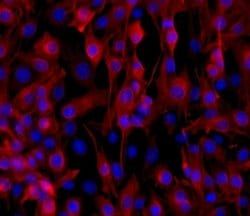
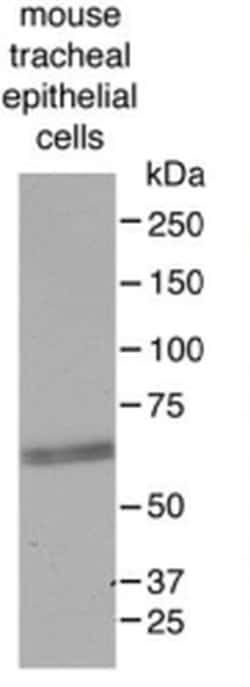
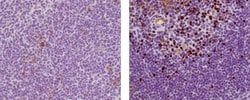
- Applications Reported: This 1G11 antibody has been reported for use in western blotting, immunohistochemical staining of formalin-fixed paraffin embedded tissue sections, microscopy, ELISA, and immunocytochemistry
- Applications Tested: This 1G11 antibody has been tested by immunocytochemistry of fixed and permeabilized HeLa cells and can be used at less than or equal to 1 μg/mL
- It is recommended that the antibody be carefully titrated for optimal performance in the assay of interest
- Purity: Greater than 90%, as determined by SDS-PAGE
- Aggregation: Less than 10%, as determined by HPLC
- Filtration: 0.2 μm post-manufacturing filtered
- Early endosomal antigen 1 (EEA1) is a 162 kDa membrane bound protein component specific to the early endosome and is essential for fusion between early endocytic vesicles
- Early endosomes are cytoplasmic compartments which fuse with endocytic vesicles for redistribution of extracellular compounds to alternate destinations
- Zinc-finger-like domains, reminiscent of those found in nucleic acid binding proteins, are located in the amino and carboxyl-terminal domains of EEA1
- The carboxyl-terminal zinc-finger-like-domain is conserved in several other non-nuclear proteins, some of which are also involved in intracellular protein trafficking
- In addition, this domain is an authentic zinc-binding domain and is critical to the intracellular localization of EEA1
- Membrane association of EEA1 has been shown dependent on phosphatidyl 3-kinase activity, inhibitors of which cause EEA1 to dissociate from early endosomes.