7090053
CD66b Monoclonal Antibody (G10F5), APC, eBioscience™, Invitrogen™
Mouse Monoclonal Antibody
Manufacturer: Fischer Scientific
The price for this product is unavailable. Please request a quote
Antigen
CD66b
Concentration
5 μL/Test
Classification
Monoclonal
Form
Liquid
Regulatory Status
RUO
Formulation
PBS with 0.2% BSA and 0.09% sodium azide; pH 7.2
Gene Alias
carcinoembryonic antigen CGM6; carcinoembryonic antigen gene family member 6; carcinoembryonic antigen related cell adhesion molecule 8; carcinoembryonic antigen-related cell adhesion molecule 8; CD66b; CD67; CD67 antigen; CEACAM8; CGM6; NCA-95; non-specific cross-reacting antigen NCA-95
Gene Symbols
CEACAM8
Primary or Secondary
Primary
Content And Storage
4° C, store in dark, DO NOT FREEZE!
Gene
CEACAM8
Clone
G10F5
Applications
Flow Cytometry
Conjugate
APC
Host Species
Mouse
Target Species
Human
Gene Accession No.
P31997
Gene ID (Entrez)
1088
Isotype
IgM κ
Purification Method
Affinity chromatography
Product Type
Antibody
Related Products

Description
- Description: This G10F5 monoclonal antibody reacts with human CD66b, one of four members of the CD66 family of granulocyte-specific activation antigens
- Expressed on neutrophils and eosinophils, CD66b is upregulated following stimulation
- This glycosyl-phosphatidylinositol-linked cell surface receptor plays a role in regulating neutrophil activation and adhesion to fibronectin, galectin-3, and E-selectin
- Applications Reported: This G10F5 antibody has been reported for use in flow cytometric analysis
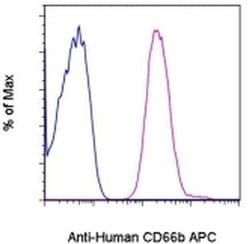
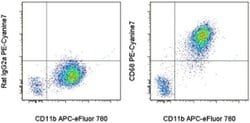
- Applications Tested: This G10F5 antibody has been pre-titrated and tested by flow cytometric analysis of normal human peripheral blood cells
- This can be used at 5 μL (0.125 μg) per test
- A test is defined as the amount (μg) of antibody that will stain a cell sample in a final volume of 100 μL
- Cell number should be determined empirically but can range from 10^5 to 10^8 cells/test
- Excitation: 633-647 nm; Emission: 660 nm; Laser: Red Laser
- Filtration: 0.2 μm post-manufacturing filtered
- This gene encodes a member of the carcinoembryonic antigen (CEA) gene family, which belongs to the immunoglobulin superfamily
- Two subgroups of the CEA family, the CEA cell adhesion molecules and the pregnancy-specific glycoproteins, are located within a 1.2 Mb cluster on the long arm of chromosome 19
- Eleven pseudogenes of the CEA cell adhesion molecule subgroup are also found in the cluster
- The encoded protein was originally described in bile ducts of liver as biliary glycoprotein
- Subsequently, it was found to be a cell-cell adhesion molecule detected on leukocytes, epithelia, and endothelia
- The encoded protein mediates cell adhesion via homophilic as well as heterophilic binding to other proteins of the subgroup
- Multiple cellular activities have been attributed to the encoded protein, including roles in the differentiation and arrangement of tissue three-dimensional structure, angiogenesis, apoptosis, tumor suppression, metastasis, and the modulation of innate and adaptive immune responses
- Multiple transcript variants encoding different isoforms have been reported, but the full-length nature of all variants has not been defined.