GFAP Monoclonal Antibody (GA5), eFluor™ 615, eBioscience™, Invitrogen™
Mouse Monoclonal Antibody
Manufacturer: Fischer Scientific
The price for this product is unavailable. Please request a quote
Antigen
GFAP
Concentration
0.2 mg/mL
Classification
Monoclonal
Form
Liquid
Regulatory Status
RUO
Formulation
PBS with 0.09% sodium azide; pH 7.2
Gene Alias
6330404F12Rik; 65 kDa glutamic acid decarboxylase; AI836096; ALXDRD; Astrocyte or Intermediate Filament Protein; cb345; class III intermediate filament protein; etID36982.3; FLJ45472; GAD(65); Gad2; Gad-2; GAD65; GAD-65; GFAP; GFAP epsilon; gfap protein; gfapl; glial fibrillary acidic protein; Glial Fibrillary Acidic Protein (GFAP); glial fibrillary acidic protein alpha; glutamate decarboxylase 2; Glutamate decarboxylase 65 kDa isoform; glutamic acid decarboxylase 2; I79_011607; intermediate filament; intermediate filament protein; intermediate filament protein; GFAP; Unknown (protein for MGC:139638); wu:fb34h11; wu:fk42c12; xx:af506734; zgc:110485; zGFAP; intermediate filament protein; zrf-1 antigen
Gene Symbols
GFAP
Primary or Secondary
Primary
Content And Storage
4° C, store in dark, DO NOT FREEZE!
Gene
GFAP
Clone
GA5
Applications
Immunocytochemistry, Immunohistochemistry (Frozen)
Conjugate
eFluor 615
Host Species
Mouse
Target Species
Chicken, Human, Mouse, Porcine, Rabbit, Rat
Gene Accession No.
P03995, P14136, P47819
Gene ID (Entrez)
100352532, 14580, 24387, 2670, 396562, 419969
Isotype
IgG1
Purification Method
Affinity chromatography
Product Type
Antibody
Related Products
Description
- Description: This GA5 monoclonal antibody reacts with human, mouse, rat, chicken, rabbit, and pig glial fibrillary acidic protein (GFAP)
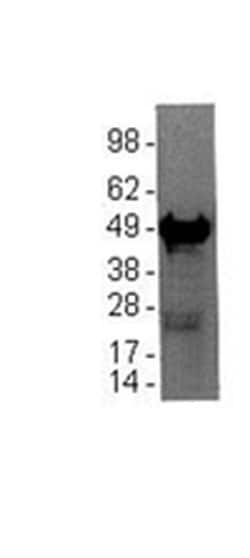
- This 49-kDa type III intermediate filament protein is expressed in neural tissues and distinguishes astrocytes from other glial cells during central nervous system development
- Three alternative splice variants of GFAP exist; however, alpha-GFAP is the predomit form expressed in astrocytes
- GFAP can co-assemble with vimentin and nestin in astrocytes, but such associations are not required for assembly
- Like other intermediate filaments, GFAP assembly is dependent on phosphorylation and dephosphorylation of the N-terminal domain
- Studies have demonstrated that mutations in the GFAP gene lead to Alexander disease
- Moreover, GFAP has also been shown to be overexpressed in certain glial-derived tumors
- Applications Reported: This GA5 antibody has been reported for use in immunocytochemical (ICC) and immunohistochemical staining of frozen tissue sections (IHC-F)
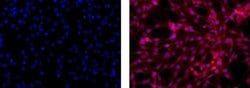
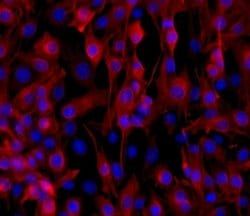
- Applications Tested: This GA5 antibody has been tested by immunocytochemistry on fixed and permeabilized C6 cells at less than or equal to 10 μg/mL
- This product has not been validated for flow cytometric analysis
- Filter Recommendation: When using this eFluor™ 615 antibody conjugate, we recommend a filter that will capture the 615 emission wavelength (for example, Excitation 560/55, 585LP, Emission 645/75)
- GFAP (Glial fibrillary acidic protein) is a member of the class III intermediate filament protein family
- GFAP is heavily and specifically expressed in astrocytes and certain astroglia of the central nervous system, in satellite cells of peripheral ganglia, and in non-myelinating Schwann cells of peripheral nerves
- In addition, neural stem cells strongly express GFAP
- Antibodies to GFAP are very useful as markers of astrocytic cells
- In addition, many types of brain tumor, presumably derived from astrocytic cells, heavily express GFAP
- GFAP is also found in the lens epithelium, Kupffer cells of the liver, in some cells in salivary tumors and has been reported in erythrocytes
- GFAP is used as a marker to distinguish astrocytes from other glial cells during development
- Mutations in this gene cause Alexander disease, a rare disorder of astrocytes in the central nervous system
- Alternative splicing of the GFAP gene results in multiple transcript variants encoding distinct isoforms.