CD127 Monoclonal Antibody (A7R34), Alexa Fluor™ 700, eBioscience™, Invitrogen™
Rat Monoclonal Antibody
Manufacturer: Fischer Scientific
The price for this product is unavailable. Please request a quote
Antigen
CD127
Concentration
0.2 mg/mL
Classification
Monoclonal
Form
Liquid
Regulatory Status
RUO
Formulation
PBS with 0.09% sodium azide; pH 7.2
Gene Alias
CD127; CD127 antigen; CDW127; IL 7 receptor; IL 7R a; IL 7R subunit alpha; IL 7R a; IL 7Ra; IL 7Ra; IL7 receptor; IL-7 receptor alpha chain; IL7 receptor subunit alpha; IL-7 receptor subunit alpha; IL7R; IL-7R; IL7R a; IL7R alpha; IL7R subunit alpha; IL-7R subunit alpha; IL7R a; IL7RA; IL-7RA; IL-7Ralpha; IL-7R-alpha; IL7Ra; ILRA; interleukin 7 receptor; interleukin 7 receptor alpha chain; interleukin 7 receptor isoform H5-6; Interleukin7 receptor subunit alpha; interleukin-7 receptor subunit alpha; MGC107557; sCD127; soluble IL 7 receptor; soluble IL 7R
Gene Symbols
Il7r
Primary or Secondary
Primary
Content And Storage
4° C, store in dark, DO NOT FREEZE!
Gene
Il7r
Clone
A7R34
Applications
Flow Cytometry
Conjugate
Alexa Fluor 700
Host Species
Rat
Target Species
Mouse
Gene Accession No.
P16872
Gene ID (Entrez)
16197
Isotype
IgG2a κ
Purification Method
Affinity chromatography
Product Type
Antibody
Related Products


Description
- Description: The A7R34 monoclonal antibody reacts with mouse CD127, the high affinity alpha subunit of the mouse IL-7 receptor
- IL-7 receptor alpha chain is expressed by immature B cells in the bone marrow, double-negative (CD4-CD8-), single-positive (CD4+ and CD8+), but not double-positive (CD4+CD8+) thymocytes
- In the periphery, mature T cells express CD127 at low level
- A7R34 inhibits binding of IL-7 to its receptor and has been used in in vivo and in vitro studies to elucidate the role of IL-7 in T and B cell development and activation
- Binding of A7R34 blocks the binding of SB/199, another antibody which recognizes mouse CD127
- Applications Reported: This A7R34 antibody has been reported for use in flow cytometric analysis
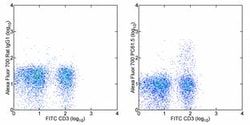
- Applications Tested: This A7R34 antibody has been tested by flow cytometric analysis of mouse thymocyte and splenocyte suspensions
- This can be used at less than or equal to 1 μg per test
- A test is defined as the amount (μg) of antibody that will stain a cell sample in a final volume of 100 μL
- Cell number should be determined empirically but can range from 10^5 to 10^8 cells/test
- It is recommended that the antibody be carefully titrated for optimal performance in the assay of interest
- Alexa Fluor™ 700 emits at 723 nm and can be excited with the red laser (633 nm)
- Most instruments will require a 685 LP mirror and 710/20 filter
- CD127 (Interleukin-7, IL-7) is a glycoprotein involved in the regulation of lymphopoiesis
- The response of cells to CD127 is dependent on the presence of the interleukin 7 receptor (IL7R); the active receptor is an alpha/gamma chain heterodimer
- CD127 consists of an alpha chain and a gamma chain
- The gamma(c) chain, which also associates with the interleukin-2 receptor, serves primarily to activate signal transduction by the IL7R complex, while the alpha chain of IL7R determines specific signaling events through its association with cytoplasmic signaling molecules
- CD127 promotes the proliferation of precursor B cells, thymocytes, T cell progenitors, and mature CD4+ and CD8+ T cells
- The biological effects of IL7 are mediated by the binding of IL7 to the specific cell surface receptor
- Diseases associated with CD127 dysfunction include severe combined immunodeficiency and T cell negative/B cell negative/NK positive severe combined immunodeficiency.