IL-23 p19 Monoclonal Antibody (fc23cpg), eFluor™ 660, eBioscience™, Invitrogen™
Rat Monoclonal Antibody
Manufacturer: Fischer Scientific
The price for this product is unavailable. Please request a quote
Antigen
IL-23 p19
Concentration
0.2 mg/mL
Classification
Monoclonal
Form
Liquid
Regulatory Status
RUO
Formulation
PBS with 0.09% sodium azide; pH 7.2
Gene Alias
il 23; IL 23 A; IL12B; Il-12b; Il12p40; Il-12p40; il23; IL-23; IL-23 subunit alpha; IL23A; IL-23A; IL-23-A; IL23P19; IL-23p19; ILN; Interleukin; interleukin 12B; interleukin 23 p19 subunit; interleukin 23 subunit alpha; interleukin 23, alpha subunit p19; interleukin-23 subunit alpha; Interleukin-23 subunit p19; interleukin-six, G-CSF related factor; JKA3 induced upon T-cell activation; MGC79388; P19; p40; RP23-388G23.1; SGRF; UNQ2498/PRO5798
Gene Symbols
IL23A
Isotype
IgG1 κ
Purification Method
Affinity chromatography
Product Type
Antibody
Clone
fc23cpg
Applications
Flow Cytometry
Conjugate
eFluor 660
Host Species
Rat
Target Species
Mouse
Gene Accession No.
Q9EQ14
Gene ID (Entrez)
83430
Immunogen
mouse IL-23p19 subunit
Primary or Secondary
Primary
Content And Storage
4° C, store in dark, DO NOT FREEZE!
Gene
IL23A
Related Products



Description
- Description: This fc23cpg monoclonal antibody reacts with the p19 subunit of mouse IL-23, a heterodimeric cytokine made up of two disulfide-linked subunits, p40 and p19
- It is closely related to IL-12, with which it shares the p40 subunit
- IL-23 signals through a heterodimeric receptor expressed on activated T cells, macrophages, and dendritic cells
- The receptor shares the IL-12Rbeta1 chain with IL-12, while the IL-23R chain is unique to the IL-23 receptor complex
- Binding of IL-23 to its receptor activates Jak/STAT pathways similarly to IL-12, but the two cytokines exhibit distinct functions
- Unlike IL-12, which induces T-bet and Th1 differentiation, IL-23 signaling results in RORgammat expression and supports CD4^+ T cells with the Th17 phenotype Dendritic cells and macrophages produce IL-23 in response to TLR2, TLR4, and TLR8 ligands, as well as agonists of the beta-glucan receptor, Dectin-1
- Our studies suggest donor, kinetics and type of stimulant can result in variation in IL-23 expression levels
- Recent publications suggest the p19 subunit may also exist in the absence of association with p40
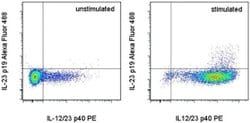
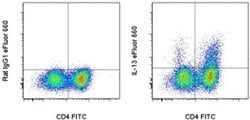
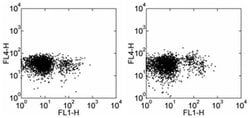
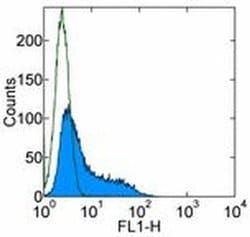
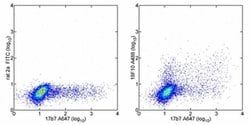
- Applications Reported: This fc23cpg antibody has been reported for use by intracellular staining and flow cytometric analysis
- Applications Tested: This fc23cpg antibody has been tested by intracellular staining and flow cytometric analysis
- This can be used at less than or equal to 0.06 μg per test
- IL-23 is a heterodimeric cytokine composed of the p40 subunit of IL-12 disulfide-linked with a protein p19
- p19, like p35 of IL-12, is biologically inactive by itself
- IL-23 interacts with IL-12Rbeta1 and an additional, novel beta2-like receptor subunit with STAT4 binding domain, termed IL-23R
- IL-23 is secreted by activated mouse and human dendritic cells
- Biological activities of mouse IL-23 are distinct from those of mouse IL-12
- Mouse IL-23 was found not to induce significant amounts of IFN-γ
- Mouse IL-23 does induce strong proliferation of memory T cells (but not naive T cells), whereas IL-12 has no effect on memory cells
- Additionally, mouse IL-23 (but not IL-12) can activate mouse memory T cells to produce the proinflammatory cytokine IL-17
- Human IL-23 has biological properties which are less distinct from human IL-12; human IL-23 induces proliferation of memory T cells and induces moderate levels of IFN-γ production by naive and memory T cells, as compared to IL-12.