IL-33R (ST2) Monoclonal Antibody (RMST2-2), APC, eBioscience™, Invitrogen™
Rat Monoclonal Antibody
Manufacturer: Fischer Scientific
The price for this product is unavailable. Please request a quote
Antigen
IL-33R (ST2)
Concentration
0.2 mg/mL
Classification
Monoclonal
Form
Liquid
Regulatory Status
RUO
Formulation
PBS with 0.09% sodium azide; pH 7.2
Gene Alias
DER4; Fit1; Fit-1; Fos-responsive gene 1 protein; growth stimulation-expressed; homolog of mouse growth stimulation-expressed; IL-1 R4; IL1RL1; IL-1RL1; IL33R; IL-33R; interleukin 1 receptor like 1; interleukin 1 receptor-like 1; interleukin 1 receptor-related protein; Interleukin1 receptor like 1; interleukin-1 receptor-like 1; Interleukin-33 receptor alpha chain; Ly84; lymphocyte antigen 84; Protein ST2; Protein T1; sIL 33R; soluble IL 33 Receptor; soluble IL 33R; St2; ST2L; St2-rs1; ST2V; Ste2; T1; T1/ST2
Gene Symbols
IL1RL1
Primary or Secondary
Primary
Content And Storage
4° C, store in dark, DO NOT FREEZE!
Gene
IL1RL1
Clone
RMST2-2
Applications
Flow Cytometry
Conjugate
APC
Host Species
Rat
Target Species
Mouse
Gene Accession No.
P14719
Gene ID (Entrez)
17082
Isotype
IgG2a κ
Purification Method
Affinity chromatography
Product Type
Antibody
Related Products



Description
- Description: The RMST2-2 monoclonal antibody reacts with ST2, also known as IL-33 receptor (IL-33R) or interleukin 1 receptor-like 1
- ST2 is a member of the IL-1 receptor family
- In the membrane-bound form, it consists of three extra-cellular immunoglobulin domains and an intracellular toll-interleukin-1 receptor domain
- ST2 forms a dimer with IL-1R accessory protein in a ligand-dependent manner
- The IL-33/ST2 interaction induces the production of TH2 cytokines
- ST2 also has a soluble isoform lacking transmembrane and intracellular toll-interleukin-1 receptor domains
- It is believed that the soluble form functions as a decoy receptor that can block membrane bound IL-33/ST2 interaction
- ST2 is expressed by TH2 lymphocytes, mast cells, eosinophils, basophils, innate lymphocytes, smooth muscle cells, and endothelial cells and is involved in host defense, allergy, and inflammation
- The IL-33/ST2 interaction has also been shown to be atheroprotective
- Applications Reported: This RMST2-2 antibody has been reported for use in flow cytometric analysis
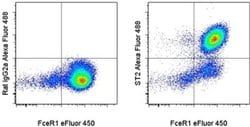
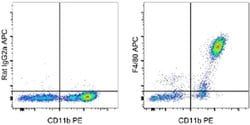
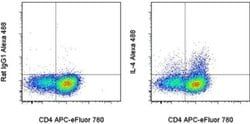
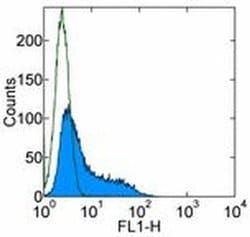
- Applications Tested: This RMST2-2 antibody has been tested by flow cytometric analysis of mouse bone marrow-derived mast cells
- This can be used at less than or equal to 0.25 μg per test
- A test is defined as the amount (μg) of antibody that will stain a cell sample in a final volume of 100 μL
- Cell number should be determined empirically but can range from 10^5 to 10^8 cells/test
- IL-33R, also known as ST2, is a receptor for IL-33
- It is a member of the IL-1 receptor family of innate receptors
- Its extracellular domain consists of 3 Ig-like domains that directly interact with its co-receptor IL-1RAcP, and the ligand alarmin, IL-33
- IL-33 ligation results in the association of IL-33R complex with its adaptor proteins MyD88, IRAK1, IRAK4 and TRAF6, and activation of the NF-kB, and MAPK pathways
- This, in turn, instigates the release of chemokines and cytokines such as IL-5, IL-6, IL-8, and IL-13
- Two most common isoforms of IL-33R that result from alternative splicing are ST2L – the membrane bound form, and ST2S – the soluble form
- The membrane bound form can be released from the cell surface by proteolytic cleavage
- The soluble forms have been suggested to act as decoys dampening the IL-33 signaling
- IL-33R is primarily expressed by mast cells, basophils, and eosinophils
- In mouse, IL-33R expression has been shown on ILC2 and Th2 cells
- IL-33R signaling has been implicated in the number of immune conditions, including allergies, arthritis, atherosclerosis and sepsis.