7092425
CD152 Hamster anti-Mouse, PE, Clone: UC10-4F10-11, BD
Hamster Monoclonal Antibody
Manufacturer: Fischer Scientific
The price for this product is unavailable. Please request a quote
Antigen
CD152
Concentration
0.2mg/mL
Classification
Monoclonal
Host Species
Hamster
Target Species
Mouse
Immunogen
Mouse CTLA-4 IgG2a Fusion
Primary or Secondary
Primary
Content And Storage
Store undiluted at 4°C and protected from prolonged exposure to light. Do not freeze.
Clone
UC10-4F10-11
Applications
Flow Cytometry
Conjugate
PE
Regulatory Status
RUO
Formulation
Aqueous buffered solution containing ≤0.09% sodium azide.
Isotype
IgG1 κ
Purification Method
Affinity Purified
Description
CTLA-4
Related Products




Description
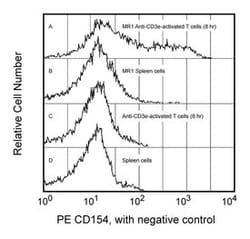
- The UC10-4F10-11 antibody reacts with CD152 (CTLA-4), which is expressed on activated T lymphocytes 2-3 days after stimulation through T cell receptor
- CTLA-4 has significant similarity to CD28 in amino acid sequence, structure, and genomic organization
- Furthermore, CD152 and CD28 share common B7 family counter-receptors
- Unlike CD28, CD152 expression appears to be restricted to activated T cells and CD25+CD4+ regulatory T (Treg) cells
- Whereas CD28 delivers a costimulatory signal required for T-cell activation, CTLA-4 is a negative regulator of cell-mediated immune responses
- CD152 may play roles in induction and/or maintenance of immunological tolerance, regulation of protective immunity, and autoimmune responses, and regulation of some aspects of thymocyte maturation
- This hamster mAb to a mouse leukocyte antigen does not cross-react with rat leukocytes.