7139416
Axl Monoclonal Antibody (MAXL8DS), PE-Cyanine7, eBioscience™, Invitrogen™
Rat Monoclonal Antibody
Manufacturer: Fischer Scientific
The price for this product is unavailable. Please request a quote
Antigen
Axl
Concentration
0.2 mg/mL
Classification
Monoclonal
Form
Liquid
Regulatory Status
RUO
Formulation
PBS with 0.09% sodium azide; pH 7.2
Gene Alias
Adhesion-related kinase; AI323647; ARK; AXL; AXL oncogene; AXL receptor tyrosine kinase; AXL transforming sequence/gene; AZF1; JTK11; oncogene AXL; sAXL; soluble AXL; Tyro7; Tyrosine-protein kinase receptor UFO; Ufo; ufo oncogene homolog
Gene Symbols
AXL
Isotype
IgG2a κ
Purification Method
Affinity chromatography
Product Type
Antibody
Clone
MAXL8DS
Applications
Flow Cytometry
Conjugate
PE-Cyanine7
Host Species
Rat
Target Species
Mouse
Gene Accession No.
Q00993
Gene ID (Entrez)
26362
Immunogen
C57BL/6 mouse Axl-human IgG Fc fusion protein
Primary or Secondary
Primary
Content And Storage
4° C, store in dark, DO NOT FREEZE!
Gene
AXL
Related Products


Description
- Description: This MAXL8DS monoclonal antibody recognizes mouse Axl, a member of the TAM family of tyrosine kinase receptors that also includes MerTK and Tyro3
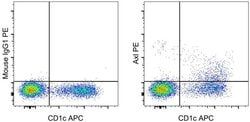
- Within hematopoietic compartment the highest expression of Axl can be observed on dendritic cells and macrophages
- Stimulation with TLR ligands has been shown to additionally upregulate this expression
- This MAXL8DS antibody will work in flow cytometry on both native and fixed/permeabilized cells
- Applications Reported: This MAXL8DS antibody has been reported for use in flow cytometric analysis
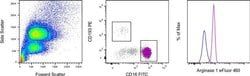
- Applications Tested: This MAXL8DS antibody has been tested by flow cytometric analysis of mouse bone marrow cells cultured in the presence of GM-CSF
- This may be used at less than or equal to 0.125 μg per test
- A test is defined as the amount (μg) of antibody that will stain a cell sample in a final volume of 100 μL
- Cell number should be determined empirically but can range from 10^5 to 10^8 cells/test
- It is recommended that the antibody be carefully titrated for optimal performance in the assay of interest
- Light sensitivity: This tandem dye is sensitive to photo-induced oxidation
- Please protect this vial and stained samples from light
- Fixation: Samples can be stored in IC Fixation Buffer (Product No
- 00-8222) (100 μL of cell sample + 100 μL of IC Fixation Buffer) or 1-step Fix/Lyse Solution (Product No
- AXL is a chronic myelogenous leukemia-associated oncogene that is also associated with colon cancer and melanoma
- The AXL protein is a receptor tyrosine kinase that transduces signals from the extracellular matrix into the cytoplasm by binding growth factors like vitamin K-dependent protein growth-arrest-specific gene 6, and is involved in the stimulation of cell proliferation
- TAM receptors are also involved in phagocytosis of apoptotic cells
- Mice lacking all three TAM receptors have several degenerative phenotypes linked to inefficient removal of apoptotic cells and membranes (e.g., in the retina and the male reproductive tract) and develop a severe autoimmune phenotype akin to systemic lupus erythematosus, including the production of broad spectrum auto-antibodies
- In addition, Axl may function as a putative entry receptor for filoviruses
- Axl is also used to identify a specific subpopulation of human blood dendritic cells, also referred to as Siglec 6+/Axl+ dendritic cells
- Cellular expression of Axl can be upregulated by TLR ligands, such as LPS or poly I:C
- Soluble Axl is generated by proteolytic cleavage of the membrane form
- Increased plasma levels may be indicative of inflammation and cancer.