7144066
BAF57/SMARCE1 Polyclonal Antibody, Bethyl Laboratories
Rabbit Polyclonal Antibody
Manufacturer: Fischer Scientific
The price for this product is unavailable. Please request a quote
Antigen
BAF57/SMARCE1
Classification
Polyclonal
Form
Liquid
Regulatory Status
RUO
Formulation
TBS with 0.1% BSA and 0.09% sodium azide
Gene Alias
SMARCE1; BAF57; SWI/SNF related, matrix associated, actin dependent regulator of chromatin, subfamily e, member 1; mammalian chromatin remodeling complex BRG1-associated factor 57; BAF57; SWI/SNF-related matrix-associated actin-dependent regulator of chromatin e1
Immunogen
Between 360 and C-term
Primary or Secondary
Primary
Content And Storage
4° C
Gene
SMARCE1
Applications
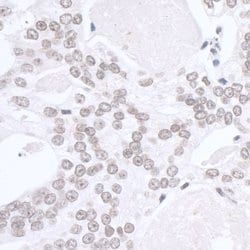
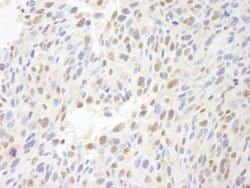
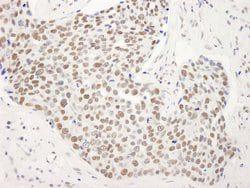
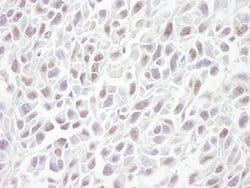
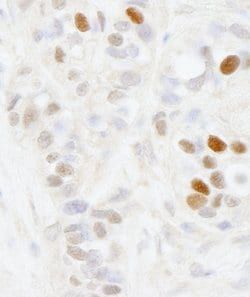
Immunohistochemistry
Conjugate
Unconjugated
Host Species
Rabbit
Target Species
Human, Mouse
Gene Accession No.
O54941, Q969G3
Gene ID (Entrez)
57376, 6605
Isotype
IgG
Purification Method
Antigen affinity chromatography
Product Type
Antibody
Related Products


Description
- The recommended shelf life for this product is 1 year from date of receipt
- The protein encoded by this gene is part of the large ATP-dependent chromatin remodeling complex SWI/SNF, which is required for transcriptional activation of genes normally repressed by chromatin
- The encoded protein, either alone or when in the SWI/SNF complex, can bind to 4-way junction DNA, which is thought to mimic the topology of DNA as it enters or exits the nucleosome
- The protein contains a DNA-binding HMG domain, but disruption of this domain does not abolish the DNA-binding or nucleosome-displacement activities of the SWI/SNF complex
- Unlike most of the SWI/SNF complex proteins, this protein has no yeast counterpart.