7144077
SMAR1/BANP Polyclonal Antibody, Bethyl Laboratories
Rabbit Polyclonal Antibody
Manufacturer: Fischer Scientific
The price for this product is unavailable. Please request a quote
Antigen
SMAR1/BANP
Classification
Polyclonal
Form
Liquid
Regulatory Status
RUO
Formulation
TBS with 0.1% BSA and 0.09% sodium azide
Gene Alias
BEND1, SMAR1, SMARBP1; BEN domain-containing protein 1; protein BANP; scaffold/matrix-associated region-1-binding protein
Immunogen
Between 425 and C-term
Primary or Secondary
Primary
Content And Storage
4° C
Gene
BANP
Applications
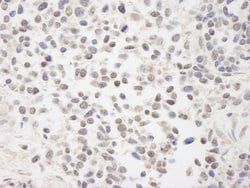
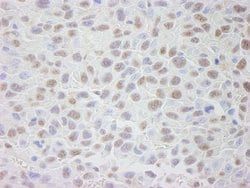
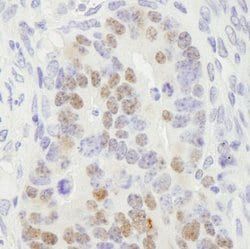
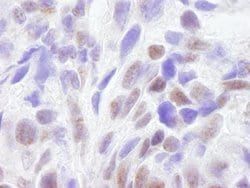
Immunohistochemistry
Conjugate
Unconjugated
Host Species
Rabbit
Target Species
Human, Mouse
Gene Accession No.
Q8N9N5, Q8VBU8
Gene ID (Entrez)
53325, 54971
Isotype
IgG
Purification Method
Antigen affinity chromatography
Product Type
Antibody
Related Products



Description
- The recommended shelf life for this product is 1 year from date of receipt
- Based on 100% sequence identity, this antibody is predicted to react with Rat, Bovine, Dog, Horse, Rabbit, Guinea pig_10141, Panda, Orangutan, Monkey, Chimpanzee, C BANP was initially identified as a binding protein to BTG3 in a yeast two-hybrid screen
- BANP acts as a tumor suppressor by stabilizing p53 expression and leading to cell cycle arrest
- p53 in turn binds to upstream elements of the BANP promoter, thereby forming a feedback loop
- BANP is down-regulated in advanced stages of human breast cancer, and its overexpression in breast cancer cell lines inhibits their ability to metastasize by modulating TGF-beta signaling
- Furthermore, BANP can modulate NF-kappa-B transactivation and can inhibit tumorigenesis by regulating NF-kappa-B target genes
- Recent experiments have shown that BANP can also repress HIV-1 LTR mediated transcription by tethering the LTR matrix attachment region to nuclear matrix.