7144075
CSE1 Polyclonal Antibody, Bethyl Laboratories
Rabbit Polyclonal Antibody
Manufacturer: Fischer Scientific
The price for this product is unavailable. Please request a quote
Antigen
CSE1
Classification
Polyclonal
Form
Liquid
Regulatory Status
RUO
Formulation
TBS with 0.1% BSA and 0.09% sodium azide
Gene Alias
CAS, CSE1, MGC117283, MGC130036, MGC130037, XPO2
Immunogen
Between 1 and 50
Primary or Secondary
Primary
Content And Storage
4° C
Gene
CSE1L
Applications
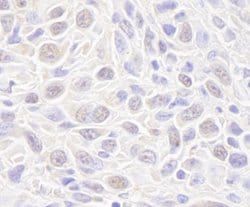
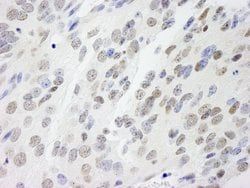
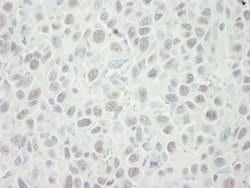
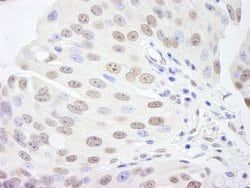
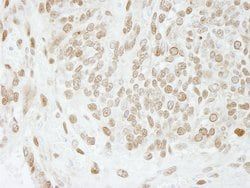
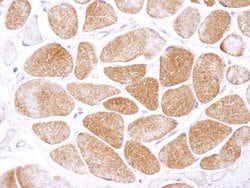
Immunohistochemistry
Conjugate
Unconjugated
Host Species
Rabbit
Target Species
Human, Mouse
Gene Accession No.
P55060, Q9ERK4
Gene ID (Entrez)
110750, 1434
Isotype
IgG
Purification Method
Antigen affinity chromatography
Product Type
Antibody
Related Products
Description
- The recommended shelf life for this product is 1 year from date of receipt
- Based on 100% sequence identity, this antibody is predicted to react with Rat, Chicken, Turkey, Bovine, Horse, Rabbit, Guinea pig_10141, Pig, Panda, Orangutan, Monk Proteins that carry a nuclear localization signal (NLS) are transported into the nucleus by the importin-alpha/beta heterodimer
- Importin-alpha binds the NLS, while importin-beta mediates translocation through the nuclear pore complex
- After translocation, RanGTP binds importin-beta and displaces importin-alpha
- Importin-alpha must then be returned to the cytoplasm, leaving the NLS protein behind
- The protein encoded by this gene binds strongly to NLS-free importin-alpha, and this binding is released in the cytoplasm by the combined action of RANBP1 and RANGAP1
- In addition, the encoded protein may play a role both in apoptosis and in cell proliferation
- [provided by RefSeq].