7144070
4EBP1 Polyclonal Antibody, Bethyl Laboratories
Rabbit Polyclonal Antibody
Manufacturer: Fischer Scientific
The price for this product is unavailable. Please request a quote
Antigen
4EBP1
Classification
Polyclonal
Form
Liquid
Regulatory Status
RUO
Formulation
TBS with 0.1% BSA and 0.09% sodium azide
Gene Alias
4E-BP1; eIF4E-binding protein 1; Phosphorylated heat- and acid-stable protein regulated by insulin 1; PHAS-I
Immunogen
Between 75 and C-term
Primary or Secondary
Primary
Content And Storage
4° C
Gene
EIF4EBP1
Applications
Immunohistochemistry
Conjugate
Unconjugated
Host Species
Rabbit
Target Species
Human, Mouse
Gene Accession No.
Q13541, Q60876
Gene ID (Entrez)
13685, 1978
Isotype
IgG
Purification Method
Antigen affinity chromatography
Product Type
Antibody
Related Products
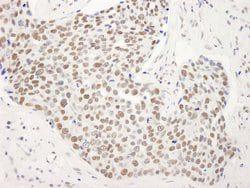

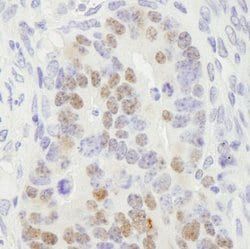
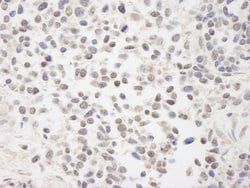
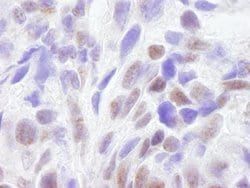
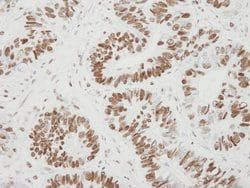
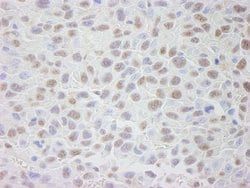

Description
- The recommended shelf life for this product is 1 year from date of receipt
- Based on 100% sequence identity, this antibody is predicted to react with Rat, Rabbit, Pig, Orangutan, Monkey, Gorilla, Chimpanzee, hirteen-lined ground squirrel, Chinese EIF4EBP1 is one member of a family of translation repressor proteins
- It directly interacts with eukaryotic translation initiation factor 4E (eIF4E), which is a limiting component of the multisubunit complex that recruits 40S ribosomal subunits to the 5' end of mRNAs
- Interaction of this protein with eIF4E inhibits complex assembly and represses translation
- This protein is phosphorylated in response to various signals including UV irradiation and insulin signaling, resulting in its dissociation from eIF4E and activation of mRNA translation.