7144144
TRIM33/TIF1gamma Polyclonal Antibody, Bethyl Laboratories
Rabbit Polyclonal Antibody
Manufacturer: Fischer Scientific
The price for this product is unavailable. Please request a quote
Antigen
TRIM33/TIF1gamma
Classification
Polyclonal
Form
Liquid
Regulatory Status
RUO
Formulation
TBS with 0.1% BSA and 0.09% sodium azide
Gene Alias
ECTO, PTC7, RFG7, TF1G, TIF1G, TIF1GAMMA, TIFGAMMA, TRIM33, tripartite motif containing 33
Immunogen
Between 1077 and C-term
Primary or Secondary
Primary
Content And Storage
4° C
Gene
TRIM33
Applications
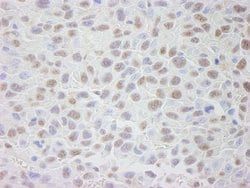
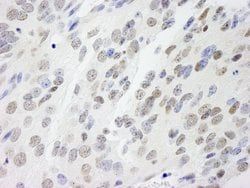
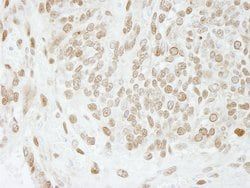
Immunohistochemistry
Conjugate
Unconjugated
Host Species
Rabbit
Target Species
Human, Mouse
Gene Accession No.
Q99PP7, Q9UPN9
Gene ID (Entrez)
51592, 94093
Isotype
IgG
Purification Method
Antigen affinity chromatography
Product Type
Antibody
Related Products


Description
- The recommended shelf life for this product is 1 year from date of receipt
- Based on 100% sequence identity, this antibody is predicted to react with Rat, X
- tropicalis, Chicken, Turkey, Bovine, Dog, Horse, Rabbit, Guinea pig_10141, Pig, Pa The protein encoded by TIF1 gamma is thought to be a transcriptional corepressor
- However, molecules that interact with this protein have not yet been identified
- The protein is a member of the tripartite motif family
- This motif includes three zinc-binding domains, a RING, a B-box type 1 and a B-box type 2, and a coiled-coil region
- Three alternatively spliced transcript variants for TIF1 gamma have been described, however, the full-length nature of one variant has not been determined.