7144195
BRF1 Polyclonal Antibody, Bethyl Laboratories
Rabbit Polyclonal Antibody
Manufacturer: Fischer Scientific
The price for this product is unavailable. Please request a quote
Antigen
BRF1
Classification
Polyclonal
Form
Liquid
Regulatory Status
RUO
Formulation
TBS with 0.1% BSA and 0.09% sodium azide
Gene Alias
Transcription factor IIIB 90 kDa subunit, TFIIIB90, hTFIIIB90, B-related factor 1, BRF-1, hBRF, TAF3B2, TATA box-binding protein-associated factor, RNA polymerase III, subunit 2, BRF1, BRF, GTF3B, TAF3B2, TAF3C
Gene Symbols
BRF1
Isotype
IgG
Purification Method
Antigen affinity chromatography
Product Type
Antibody
Applications
Immunohistochemistry
Conjugate
Unconjugated
Host Species
Rabbit
Target Species
Human
Gene Accession No.
Q92994
Gene ID (Entrez)
2972
Immunogen
Between 627 and 677
Primary or Secondary
Primary
Content And Storage
4° C
Gene
BRF1
Related Products
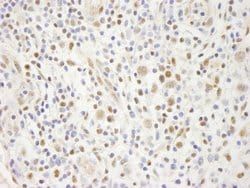
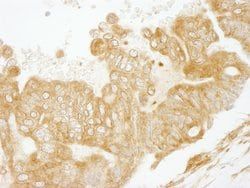
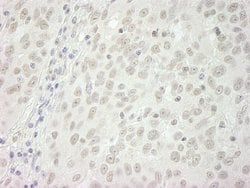
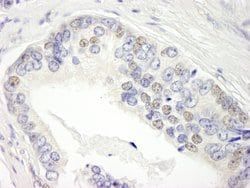
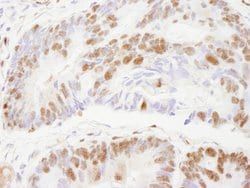
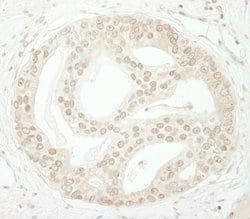
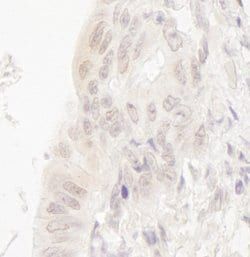
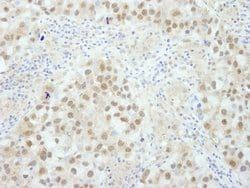
Description
- The recommended shelf life for this product is 1 year from date of receipt
- Based on 100% sequence identity, this antibody is predicted to react with Mouse, Rat, Orangutan, Monkey, Gorilla, Chimpanzee, Northern white-cheeked gibbon and Chinese ham RNA polymerase (pol) III synthesizes tRNA, 5s rRNA, 7SL RNA and U6 snRNA and is overexpressed in many transformed cell lines and tumors in vivo, since cells must duplicate its protein components before division
- Therefore, in order to maintain rapid growth, cells must produce a high level of Pol III transcribed RNA, which requires the presence of the TFIIIB and TFIIIC2 transcription factor complexes
- The TFIIIC2 complex is composed of five subunits, TFIIIC220, TFIIIC110, TFIIIC102, TFIIIC90 and TFIIIC63, that are overexpressed in adenovirus transformed cells as well as in maligt cells in vivo, such as ovarian carcinomas
- TFIIIC2 recruits RNA pol III and TFIIIB to promoter elements and may be a key component in the deregulation of maligt cells
- The TFIIIB complex includes the TATA-binding protein (TBP), TFIIB-related factor 1 (TFIIIB90, BRF1) and TFIIIB, the expression of which are also upregulated in transformed cells
- In many carcinomas, the tumor suppressors retinoblastoma (RB) and p53 are inactivated, which affects their ability to bind and inactivate the function of TFIIIB.