7162941
Neuritin (CPG15), Mouse anti-Human, Rat, Clone: A6.1, Millipore Sigma™
Mouse Monoclonal Antibody
Manufacturer: Fischer Scientific
The price for this product is unavailable. Please request a quote
Antigen
Neuritin (CPG15)
Applications
Western Blot
Conjugate
Unconjugated
Host Species
Mouse
Research Discipline
Neuroscience
Formulation
Purified mouse monoclonal antibody IgG2b in buffer containing 0.1 M Tris-Glycine (pH 7.4), 150 mM NaCl with 0.05% sodium azide.
Gene ID (Entrez)
NP_001265639
Immunogen
GST-tagged full-length human recombinant Neuritin.
Primary or Secondary
Primary
Content And Storage
Stable for 1 year at 2-8°C from date of receipt.
Clone
A6.1
Classification
Monoclonal
Form
Purified
Regulatory Status
RUO
Target Species
Human, Rat
Gene Alias
candidate plasticity gene 15;CPG15
Gene Symbols
NRN1;NRN
Isotype
IgG2b κ
Purification Method
Protein G purified
Test Specificity
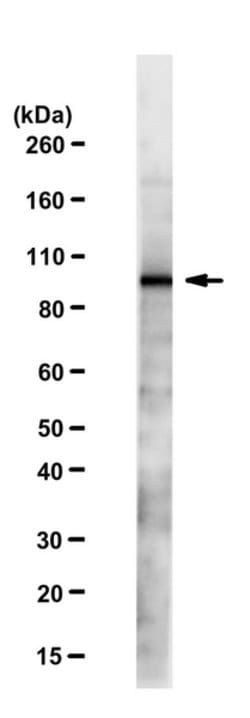
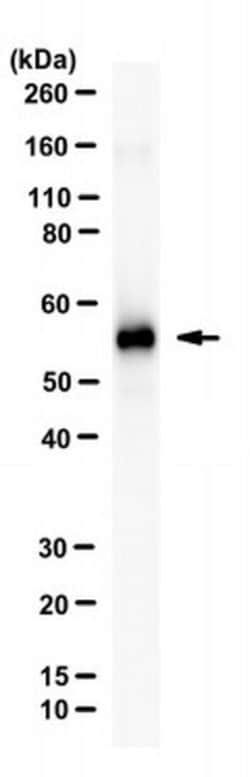
Clone A6.1 detects human and rat Neuritin.
Related Products
Description
- Anti-Neuritin (CPG15), clone A6.1, Cat
- No
- MABN1840, is a highly specific mouse monoclonal antibody that targets Neuritin and has been tested for use in Western Blotting
- Neuritin (UniProt: Q9NPD7) is encoded by the NRN1 (also known as NRN) gene (Gene ID: 51299) in human
- Neuritin, a conserved, glycosylphosphatidylinositol (GPI)-anchored protein that plays a role in the development, survival and function of neurons
- Its activity is induced by brain-derived neurotrophic factor (BDNF) and neurotrophin-3 (NT-3)
- It is highly expressed by induced and natural regulatory T cells (TREGs)
- It also promotes the maintenance of the TREGs pool by stabilizing Foxp3 expression and promoting the persistence of these cells
- Deficiency of Neuritin is shown to result in an imbalance between central and peripheral TREG populations and functions
- Neuritin has a wide variety of effects in the nervous system, such as promoting neurite outgrowth, modulating neurite outgrowth during neuronal differentiation, and protecting motor neuron axons
- It can also promote dendritic growth, regulate synaptic plasticity, and stabilize active synapses, and promote synaptic maturation
- Its expression in the hippocampus is shown to be induced by neuronal activity following chemical- or electrical-induced seizures, ischemia, and exercise
- Chronic antidepressant treatment is reported to increase neuritin expression in rat brain
- Neuritin is synthesized with a signal peptide (aa 1-27) and a propeptide (aa 28-116) that are cleaved off in the mature form (aa 117-142)
- (Ref.: Son, H., et al
- (2012)
- Proc
- Natl
- Acad
- Sci
- USA
- 109(28); 11378-83; Zhou, S., and Zhou, J (2014)
- Curr
- Med
- Chem
- 21(10); 1212-19)
- Note: A6.1 hybridoma clone, and WT/KO validation, courtesy of Lauren Makuch and Dr
- Elly Nedivi, Massachusetts Institute of Technology
- Note: A6.1 hybridoma clone, and WT/KO validation, courtesy of Dr
- Lauren Makuch and Dr
- Elly Nedivi, Massachusetts Institute of Technology.