7188698
Histone H2BK120ub1 Monoclonal Antibody (56), Active Motif™
Mouse Monoclonal Antibody
Manufacturer: Fischer Scientific
The price for this product is unavailable. Please request a quote
Antigen
Histone H2BK120ub1
Concentration
1 mg/mL
Classification
Monoclonal
Form
Liquid
Regulatory Status
RUO
Formulation
70mM tris with 0.07mM EDTA, 105mM NaCl, 30% glycerol, 31mM glycine and 0.035% sodium azide; pH 8
Gene ID (Entrez)
255626
Immunogen
This Histone H2B ubiquityl Lys120 antibody was raised against a branched peptide corresponding the the ubiquitin conjugation site at Lys120 of human Histone H2B.
Primary or Secondary
Primary
Content And Storage
-20°C, Avoid Freeze/Thaw Cycles
Gene
HIST1H2BA
Clone
56
Applications
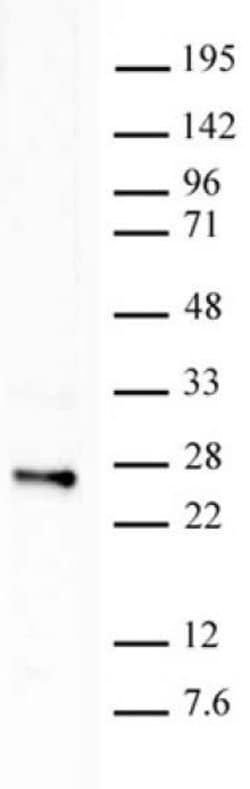
Western Blot
Conjugate
Unconjugated
Host Species
Mouse
Target Species
Human
Gene Accession No.
Q96A08
Gene Symbols
HIST1H2BA
Isotype
IgG2a
Purification Method
Protein G
Product Type
Antibody
Related Products
Description
- Histones are basic nuclear proteins that are responsible for the nucleosome structure of the chromosomal fiber in eukaryotes
- Two molecules of each of the four core histones (H2A, H2B, H3, and H4) form an octamer, around which approximately 146 bp of DNA is wrapped in repeating units, called nucleosomes
- The linker histone, H1, interacts with linker DNA between nucleosomes and functions in the compaction of chromatin into higher order structures
- This gene encodes a member of the histone H2A family and generates two transcripts through the use of the conserved stem-loop termination motif, and the polyA addition motif.