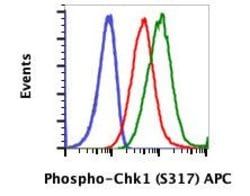
Phospho-Chk1 (Ser317) Recombinant Rabbit Monoclonal Antibody (Chk1S317-G1), APC, Invitrogen™
Rabbit Recombinant Monoclonal Antibody
Manufacturer: Fischer Scientific
The price for this product is unavailable. Please request a quote
Antigen
Phospho-Chk1 (Ser317)
Applications
Flow Cytometry
Conjugate
APC
Host Species
Rabbit
Target Species
Human, Mouse
Gene Accession No.
O14757, O35280
Gene ID (Entrez)
1111, 12649
Immunogen
A synthetic phospho-peptide corresponding to residues surrounding Ser317 of human phospho Chk1.
Primary or Secondary
Primary
Content And Storage
4° C
Gene
Chek1
Clone
Chk1S317-G1
Classification
Monoclonal
Form
Liquid
Regulatory Status
RUO
Formulation
PBS with 0.20% BSA and 0.09% sodium azide
Gene Alias
C85740; Cell cycle checkpoint kinase; checkpoint kinase 1; checkpoint kinase 1 homolog; checkpoint kinase-1; Checkpoint, S. pombe, homolog of, 1; CHEK1; CHK1; CHK1 checkpoint homolog; Chk1-S; homolog of Chk1-S; HRD1 Protein; rad27; rad27 homolog; serine/threonine protein kinase CHK1; serine/threonine-protein kinase Chk1; Synoviolin; YBR1742; YBR274W
Gene Symbols
Chek1
Isotype
IgG κ
Purification Method
Protein A/G
Product Type
Antibody
Related Products

Description
- CHEK1 (CHK1) is a serine/threonine protein kinase involved in preventing replication when DNA integrity is compromised
- CHK1 is a key mediator in the DNA damage-induced checkpoint network
- CHK1 is an evolutionarily conserved protein kinase that functions to ensure genomic integrity upon genotoxic stress
- When the G2 or S checkpoint is abrogated by the inhibition of CHK1, p53-deficient cancer cells undergo mitotic catastrophe and eventually apoptosis, whereas normal cells are still arrested in the G1 phase
- Thus, CHK1 inhibitors can preferentially potentiate the efficacy of DNA damaging agents in cancer cells, and Chk1 is an attractive therapeutic target for cancer treatment, especially since approximately 50% of all human cancers are p53-deficient.