CD103 (Integrin alpha E) Monoclonal Antibody (B-Ly7), eBioscience™, Invitrogen™
Mouse Monoclonal Antibody
Manufacturer: Fischer Scientific
The price for this product is unavailable. Please request a quote
Antigen
CD103 (Integrin alpha E)
Concentration
0.5 mg/mL
Classification
Monoclonal
Form
Liquid
Regulatory Status
RUO
Formulation
PBS with 0.09% sodium azide; pH 7.2
Gene Alias
A530055J10; alpha-E1; alpha-M290; aM290; antigen CD103; antigen CD103, human mucosal lymphocyte antigen 1; alpha polypeptide; CD103; DC; DCs; HML-1 antigen; human mucosal lymphocyte antigen 1, alpha polypeptide; HUMINAE; integrin alpha E; integrin alpha E, epithelial-associated; integrin alpha E1, epithelial-associated; integrin alpha M290; Integrin alpha-E; Integrin alpha-E heavy chain; Integrin alpha-E light chain; Integrin alpha-IEL; integrin subunit alpha E; integrin, alpha E; integrin, alpha E (antigen CD103, human mucosal lymphocyte antigen 1; alpha polypeptide); integrin, alpha E, epithelial-associated; Intregrin alpha E2; Itgae; MGC141996; Mucosal lymphocyte 1 antigen
Gene Symbols
Itgae
Primary or Secondary
Primary
Content And Storage
4° C
Gene
Itgae
Clone
B-Ly7
Applications
Flow Cytometry, Immunohistochemistry (Frozen)
Conjugate
Unconjugated
Host Species
Mouse
Target Species
Human
Gene Accession No.
P38570
Gene ID (Entrez)
3682
Isotype
IgG1 κ
Purification Method
Affinity chromatography
Product Type
Antibody
Related Products
Description
- Description: The B-Ly7 monoclonal antibody reacts with human CD103, the alpha E integrin
- CD103 non-covalently associates with integrin beta 7
- CD103 is expressed mainly on intraepithelial lymphocytes and a small subset of peripheral lymphocytes
- CD103 is also expressed by hairy cell leukemia (HCL) and by some chronic B cell lymphocytic leukemias
- In vitro stimulation of human T cells with mitogens induces upregulation of CD103
- Epithelial cell antigen, E-cadherin, binds to CD103 and mediates homing of lymphocytes to the intestinal epithelium
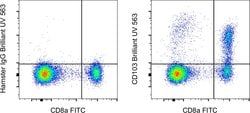
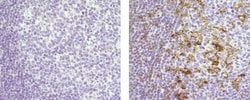
- Applications Reported: B-Ly7 has been reported for use in flow cytometric analysis, and immunohistochemical staining of frozen tissue sections
- Applications Tested: The B-Ly7 antibody has been tested by flow cytometric analysis of stimulated normal human peripheral blood cells
- This can be used at less than or equal to 0.5 μg per test
- A test is defined as the amount (μg) of antibody that will stain a cell sample in a final volume of 100 μL
- Cell number should be determined empirically but can range from 10^5 to 10^8 cells/test
- It is recommended that the antibody be carefully titrated for optimal performance in the assay of interest
- Purity: Greater than 90%, as determined by SDS-PAGE
- Aggregation: Less than 10%, as determined by HPLC
- Filtration: 0.2 μm post-manufacturing filtered
- CD103 (ITGAE, Integrin alpha E) is molecule that is expressed on mucosa-associated T lymphocytes and activated cells and on subet of TGF beta -1 cells
- In particular, CD103 includes a 150kDa alpha chain and a 120kDa beta chain
- CD103 is expressed by 0.5 to 2% of resting lymphocytes in peripheral blood and lymphoid organs
- CD103 antibody stains a few bone marrow cells and, rarely, peripheral blood lymphocytes
- CD103 is part of the integrin family which are heterodimeric integral membrane proteins composed of an alpha chain and a beta chain
- ITGAE encodes an I-domain-containing alpha integrin that undergoes post-translational cleavage in the extracellular domain, yielding disulfide-linked heavy and light chains
- In combination with the beta 7 integrin, CD103 protein forms the E-cadherin binding integrin known as the human mucosal lymphocyte-1 antigen
- CD103 is preferentially expressed in human intestinal intraepithelial lymphocytes (IEL), and in addition to a role in adhesion, it may serve as an accessory molecule for IEL activation
- Diseases associated with CD103 dysfunction include hairy cell leukemia and splenic marginal zone lymphoma.