7218846
CD19 Monoclonal Antibody (HIB19), Alexa Fluor™ 660, eBioscience™, Invitrogen™
Mouse Monoclonal Antibody
Manufacturer: Fischer Scientific
The price for this product is unavailable. Please request a quote
Antigen
CD19
Concentration
5 μL/Test
Classification
Monoclonal
Form
Liquid
Regulatory Status
RUO
Formulation
PBS with 0.2% BSA and 0.09% sodium azide; pH 7.2
Gene Alias
AW495831; B4; B-lymphocyte antigen CD19; B-lymphocyte surface antigen B4; Cd19; CD19 antigen; CD19 molecule; CVID3; differentiation antigen CD19; Leu-12; T-cell surface antigen Leu-12
Gene Symbols
Cd19
Primary or Secondary
Primary
Content And Storage
4° C, store in dark, DO NOT FREEZE!
Gene
Cd19
Clone
HIB19
Applications
Flow Cytometry
Conjugate
Alexa Fluor 660
Host Species
Mouse
Target Species
Human
Gene Accession No.
P15391
Gene ID (Entrez)
930
Isotype
IgG1 κ
Purification Method
Affinity chromatography
Product Type
Antibody
Related Products
Description
- Description: The HIB19 monoclonal antibody reacts with human CD19, a 95 kDa transmembrane glycoprotein
- CD19 is expressed by B cells during all stages of development excluding the terminally differentiated plasma cells
- Follicular dendritic cells also express CD19
- Together CD21, CD81, Leu13, MHC class II, and CD19 form a multimolecular complex that associates with BCR
- Signaling through CD19 induces tyrosine phosphorylation, calcium flux and proliferation of B cells
- The SJ25C1 antibody and the HIB19 monoclonal antibody recognize overlapping epitopes
- Applications Reported: This HIB19 antibody has been reported for use in flow cytometric analysis
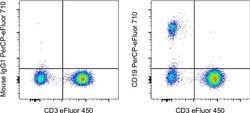
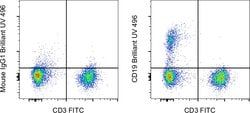
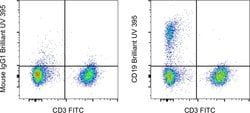
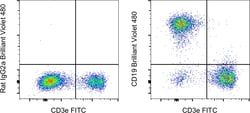
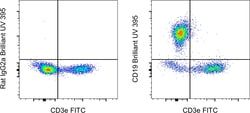
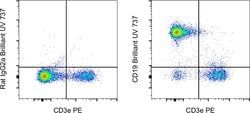
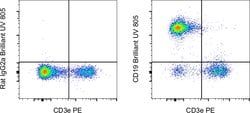
- Applications Tested: This HIB19 antibody has been pre-diluted and tested by flow cytometric analysis of normal human peripheral blood cells
- This may be used at 5 μL (0.125 μg) per test
- A test is defined as the amount (μg) of antibody that will stain a cell sample in a final volume of 100 μL
- Cell number should be determined empirically but can range from 10^5 to 10^8 cells/test
- Alexa Fluor 660 emits at 690 nm and is intended for use on spectral cytometers where it may be multiplexed with APC, Alexa Fluor 647 and Alexa Fluor 700
- Excitation: 662 nm; Emission: 690 nm; Laser: Red Laser CD19 is a member of the immunoglobulin superfamily and has two Ig like domains
- The CD19 molecule is expressed on 100% of the peripheral B cells as defined by expression of kappa or lambda light chains
- CD19 appears to be expressed on myeloid leukemia cells, particularly those of monocytic lineage
- Leukemia phenotype studies have demonstrated that the earliest and broadest B cell restricted antigen is the CD19 antigen
- The receptor for CD19 is an important functional regulator of normal and malignant B cell proliferation, and is expressed in all B cell precursor leukemias
- Lymphocytes proliferate and differentiate in response to various concentrations of different antigens
- The ability of the B cell to respond in a specific, yet sensitive manner to the various antigens is achieved with the use of low-affinity antigen receptors
- CD19 is a cell surface molecule which assembles with the antigen receptor of B lymphocytes in order to decrease the threshold for antigen receptor-dependent stimulation
- Besides being a signal-amplifying coreceptor for the B cell receptor (BCR), CD19 can also signal independently of BCR co-ligation and is a central regulatory component upon which multiple signaling pathways converge
- Mutation of the CD19 gene results in hypogammaglobulinemia, whereas CD19 overexpression causes B cell hyperactivity.