iNOS Monoclonal Antibody (CXNFT), Brilliant Ultra Violet™ 737, eBioscience™, Invitrogen™
Rat Monoclonal Antibody
Manufacturer: Fischer Scientific
The price for this product is unavailable. Please request a quote
Antigen
iNOS
Concentration
0.2 mg/mL
Classification
Monoclonal
Form
Liquid
Regulatory Status
RUO
Formulation
PBS with BSA and 0.09% sodium azide; pH 7.2
Gene Alias
Hepatocyte NOS; hepatocytes; HEP-NOS; inducible nitric oxide synthase; inducible NO synthase; Inducible NOS; iNos; i-NOS; Inosl; MAC-NOS; macrophage NOS; nitric oxide synthase 2; nitric oxide synthase 2, inducible; nitric oxide synthase 2, inducible, macrophage; nitric oxide synthase 2A (inducible, hepatocytes); nitric oxide synthase, inducible; nitric oxide synthase, macrophage; nitric oxide synthase-inducible; NOS; NOS type II; NOS, type II; Nos2; Nos-2; Nos2a; NOS-II; OTTMUSP00000000202; peptidyl-cysteine S-nitrosylase NOS2
Gene Symbols
Nos2
Primary or Secondary
Primary
Content And Storage
4° C, store in dark, DO NOT FREEZE!
Gene
Nos2
Clone
CXNFT
Applications
Flow Cytometry
Conjugate
Brilliant Ultraviolet 737
Host Species
Rat
Target Species
Mouse
Gene Accession No.
P29477
Gene ID (Entrez)
18126
Isotype
IgG2a κ
Purification Method
Affinity chromatography
Product Type
Antibody
Related Products

Description
- This CXNFT monoclonal antibody reacts to mouse NOS2 (inducible NOS, iNOS)
- Nitric oxide synthase enzymes catalyze the formation of nitric oxide from L-arginine through an NADPH- and oxygen-dependent mechanism
- There are three isoforms of NOS that are encoded by three separate genes
- NOS1 and NOS3are constitutively expressed, while NOS2 is induced in response to bacterial endotoxins and inflammatory cytokines such as IFN gamma and TNF alpha
- NOS2 is expressed by myeloid-derived suppressor cells and M1 macrophages but not alternatively activated M2 macrophages
- NOS enzymes are functionally active only when they form homodimers, and dimerization of NOS2 occurs at steady-state concentrations of free Ca2+ such that NOS2 is functionally active when it is produced
- Applications Reported: This CXNFT antibody has been reported for use in intracellular staining followed by flow cytometric analysis
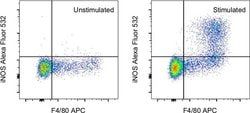
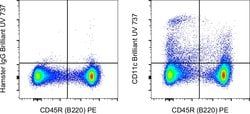
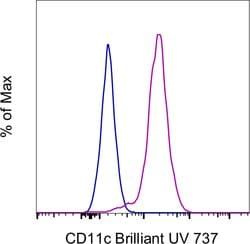
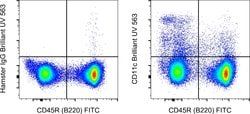
- Applications Tested: This CXNFT antibody has been tested by intracellular staining followed by flow cytometric analysis of stimulated mouse thioglycolate-elicited peritoneal macrophages using the Intracellular Fixation & Permeabilization Buffer Set (Product # 88-8824-00)
- This may be used at less than or equal to 0.125 μg per test
- Cell number should be determined empirically but can range from 10^5 to 10^8 cells/test
- Brilliant Ultraviolet 737 is a tandem dye that emits at 732 nm and is intended for use on cytometers equipped with an ultraviolet (355 nm) laser
- iNOS (Inducible Nitric oxide, NO, NOS) is an inorganic, gaseous free radical that carries a variety of messages between cells
- Vasorelaxation, neurotransmission and cytotoxicity can all be potentiated through cellular response to NO
- NO production is mediated by members of the nitric oxide synthase (NOS) family
- iNOS is expressed in liver and inducible by a combination of lipopolysaccharide and certain cytokines
- NOS catalyzes the oxidization of L-arginine to produce L-citrulline and NO
- Two constitutive isoforms, brain or neuronal NOS (b or nNOS, type I) and endothelial cell NOS (eNOS, type III), and one inducible isoform (iNOS, type II), have been cloned
- All NOS isoforms contain calmodulin, nicotinamide adenine dinucleotide phosphate (NADPH), flavin adenine dinucleotide (FAD), and flavin mononucleotide (FMN) binding domains
- iNOS is found in a variety of cell types including macrophages, hepatocytes, synoviocytes, and smooth muscle cells
- Cytokines such as interferon-gamma (IFN), tumor necrosis factor (TNF), interleukin-1 and -2, and lipopolysaccarides (LPS) cause an increase in iNOS mRNA, protein, and activity levels
- Protein kinase C-stimulating agents exhibit the same effect on iNOS activity
- After cytokine induction, iNOS exhibits a delayed activity response which is then followed by a significant increase in NO production over a long period of time
- Three related iNOS pseudogenes are located within the Smith-Magenis syndrome region on chromosome 17
- Diseases associated with iNOS dysfunction include achalasia and impotence.