CD31 (PECAM-1) Monoclonal Antibody (390), Brilliant Ultra Violet™ 661, eBioscience™, Invitrogen™
Rat Monoclonal Antibody
Manufacturer: Fischer Scientific
The price for this product is unavailable. Please request a quote
Antigen
CD31 (PECAM-1)
Concentration
0.2 mg/mL
Classification
Monoclonal
Form
Liquid
Regulatory Status
RUO
Formulation
PBS with BSA and 0.09% sodium azide; pH 7.2
Gene Alias
C85791; CD31; CD31 antigen; CD31, PECAM-1; CD31/EndoCAM; endoCAM; GPIIA'; I79_008304; PECA1; Pecam; PECAM1; Pecam-1; platelet and endothelial cell adhesion molecule 1; platelet endothelial cell adhesion molecule; platelet endothelial cell adhesion molecule-1; platelet/endothelial cell adhesion molecule (CD31 antigen); platelet/endothelial cell adhesion molecule 1; type I transmembrane endothelial adhesion molecule
Gene Symbols
Pecam1
Primary or Secondary
Primary
Content And Storage
4° C, store in dark, DO NOT FREEZE!
Gene
Pecam1
Clone
390
Applications
Flow Cytometry
Conjugate
Brilliant Ultraviolet 661
Host Species
Rat
Target Species
Mouse
Gene Accession No.
Q08481
Gene ID (Entrez)
18613
Isotype
IgG2a κ
Purification Method
Affinity chromatography
Product Type
Antibody
Related Products


Description
- The 390 mAb reacts with mouse CD31, also known as platelet-endothelial cell adhesion molecule-1 (PECAM-1) and gpIIa
- This 130-140 kDa surface protein is expressed by endothelial cells and at low levels on all leukocytes and platelets
- It has been reported that CD38 binds to CD31
- Homotypic interaction of CD31 is important in adhesion, cell-cell and cell-matrix interaction, and signal transduction
- Applications Reported: This 390 antibody has been reported for use in flow cytometric analysis
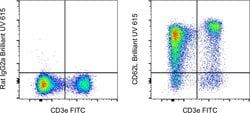
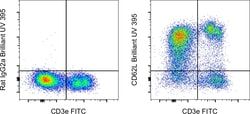
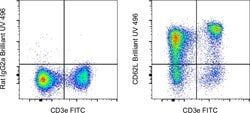
- Applications Tested: This 390 antibody has been tested by flow cytometric analysis of mouse bone marrow cells
- This may be used at less than or equal to 1.0μg per test Brilliant Ultra Violet 661 (BUV661) is a tandem dye that emits at 660 nm and is intended for use on cytometers equipped with an Ultraviolet (355 nm) laser
- Please make sure that your instrument is capable of detecting this fluorochrome
- When using two or more Super Bright, Brilliant Violet, Brilliant Ultra Violet, or other polymer dye-conjugated antibodies in a staining panel, it is recommended to use Super Bright Complete Staining Buffer (SB-4401-42) or Brilliant Stain Buffer (00-4409-75) to minimize any non-specific polymer interactions
- Light sensitivity: This tandem dye is sensitive to photo-induced oxidation
- Please protect this vial and stained samples from light
- Excitation: 350 nm; Emission: 660 nm; Laser: Ultraviolet Laser
- CD31 (platelet endothelial cell adhesion molecule-1, PECAM-1) is an inhibitory coreceptor involved in regulation of T cell and B cell signaling by a dual immunoreceptor tyrosine-based inhibitory motif (ITIM) that upon associated kinases-mediated phosphorylation provide docking sites for protein-tyrosine phosphatases
- CD31 is expressed ubiquitously within the vascular compartment and is located mainly at junctions between adjacent cells
- N-terminal Ig-like domain of CD31 is responsible for its homophilic binding, which plays an important role in cell-cell interactions
- CD31 is a multifunctional molecule with diverse roles in modulation of integrin-mediated cell adhesion, transendothelial migration, angiogenesis, apoptosis, negative regulation of immunoreceptor signaling, autoimmunity, macrophage phagocytosis, IgE-mediated anaphylaxis and thrombosis
- It is one of key regulatory molecules in vascular system.