EGFR Polyclonal Antibody, Biotin, PeproTech®, Invitrogen™
Rabbit Polyclonal Antibody
Manufacturer: Fischer Scientific
The price for this product is unavailable. Please request a quote
Antigen
EGFR
Applications
ELISA, Western Blot
Conjugate
Biotin
Host Species
Rabbit
Target Species
Human
Gene Accession No.
P00533
Gene ID (Entrez)
1956
Immunogen
CHO cells-derived Recombinant Human EGF Receptor (EGFR)
Purification Method
Antigen affinity chromatography
Gene
EGFR
Concentration
0.1-1.0 mg/mL
Classification
Polyclonal
Form
Lyophilized
Regulatory Status
RUO
Formulation
PBS with no preservative
Gene Alias
2.7.10.1; 9030024J15Rik; AI552599; avian erythroblastic leukemia viral (v-erbB) oncogene homolog; avian erythroblastic leukemia viral (v-erb-b) oncogene homolog; cell growth inhibiting protein 40; cell proliferation-inducing protein 61; EC 2.7.10.1; egf receptor; Egfr; EGFR-related peptide; epidermal growth factor receptor; epidermal growth factor receptor (erythroblastic leukemia viral (v-erb-b) oncogene homolog, avian); Epidermal growth factor receptor formerly avian erythroblastic leukemia viral (v-erbB) oncogene homolog (Erbb1); epidermal growth factor receptor, formerly avian erythroblastic leukemia viral (v-erbB) oncogene homolog (Erbb1); ERBB; ERBB1; ErbB-1; erb-b2 receptor tyrosine kinase 1; Errb1; Errp; HER1; kinase EGFR; mENA; NISBD2; Oncogene ERBB; PIG61; Proto-oncogene c-ErbB-1; receptor tyrosine-protein kinase erbB-1; Urogastrone; wa2; wa-2; Wa5; waved 2
Gene Symbols
EGFR
Primary or Secondary
Primary
Content And Storage
-20°C
Related Products

Description
- AA Seq
- of rec
- protein: LEEKKVCQGT SNKLTQLGTF EDHFLSLQRM FNNCEVVLGN LEITYVQRNY DLSFLKTIQE VAGYVLIALN TVERIPLENL QIIRGNMYYE NSYALAVLSN YDANKTGLKE LPMRNLQEIL HGAVRFSNNP ALCNVESIQW RDIVSSDFLS NMSMDFQNHL GSCQKCDPSC PNGSCWGAGE ENCQKLTKII CAQQCSGRCR GKSPSDCCHN QCAAGCTGPR ESDCLVCRKF RDEATCKDTC PPLMLYNPTT YQMDVNPEGK YSFGATCVKK CPRNYVVTDH GSCVRACGAD SYEMEEDGVR KCKKCEGPCR KVCNGIGIGE FKDSLSINAT NIKHFKNCTS ISGDLHILPV AFRGDSFTHT PPLDPQELDI LKTVKEITGF LLIQAWPENR TDLHAFENLE IIRGRTKQHG QFSLAVVSLN ITSLGLRSLK EISDGDVIIS GNKNLCYANT INWKKLFGTS GQKTKIISNR GENSCKATGQ VCHALCSPEG CWGPEPRDCV SCRNVSRGRE CVDKCNLLEG EPREFVENSE CIQCHPECLP QAMNITCTGR GPDNCIQCAH YIDGPHCVKT CPAGVMGENN TLVWKYADAG HVCHLCHPNC TYGCTGPGLE GCPTNGPKIP S
- Sandwich ELISA: To detect Hu EGF Receptor by sandwich ELISA (using 100 uL/well antibody solution) a conc
- of 0.25-1.0 ug/mL of this antibody is required
- This biotinylated polyclonal antibody, in conjunction with PeproTech Polyclonal Anti-Hu EGF Receptor (500-P306) as a capture antibody, allows the detection of at least 0.2-0.4 ng/well of rec
- Hu EGF Receptor
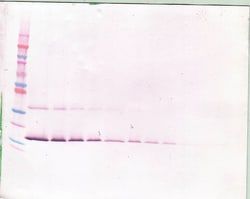
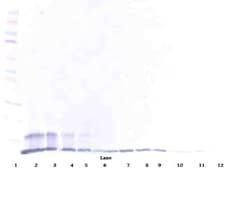
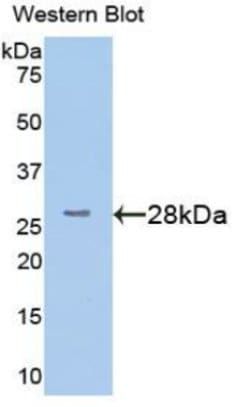
- WB: To detect Hu EGF Receptor by WB analysis this antibody can be used at a conc
- of 0.1-0.2 ug/mL
- When used in conjunction with compatible secondary reagents, the detection limit for rec
- Hu EGF Receptor is 1.5-3.0 ng/lane, under either reducing or non-reducing conditions
- EGFR, epidermal growth factor receptor, is a receptor tyrosine kinases that signals in response to various growth factors
- Overexpression has been linked to numerous types of cancer and EGFR is the target of both biological and small molecular therapeutics
- EGFR is encoded by the EGFR gene located on chromosome 7 in humans
- EGFR belongs to the HER/ERbB family of proteins that includes three other receptor tyrosine kinases, ERbB2, ERbB3, ERbB4
- EGFR is a transmembrane receptor and binding of its cognate ligands such as EGF (Epidermal Growth Factor) and TGF alpha (Transforming Growth Factor alpha) to the extracellular domain leads to EGFR dimerization followed by autophosphorylation of the tyrosine residues in the cytoplasmic domain
- Overexpression is observed in tumors of the head and neck, brain, bladder, stomach, breast, lung, endometrium, cervix, vulva, ovary, esophagus, stomach and in squamous cell carcinoma.