74-000-6M20UG
Occludin Recombinant Mouse Monoclonal Antibody (OC-3F10), Invitrogen™
Manufacturer: Fischer Scientific
Select a Size
| Pack Size | SKU | Availability | Price |
|---|---|---|---|
| Each of 1 | 74-000-6M20UG-Each-of-1 | In Stock | ₹ 17,711.00 |
74-000-6M20UG - Each of 1
In Stock
Quantity
1
Base Price: ₹ 17,711.00
GST (18%): ₹ 3,187.98
Total Price: ₹ 20,898.98
Antigen
Occludin
Classification
Recombinant Monoclonal
Concentration
1.0 mg/mL
Formulation
PBS with 0.09% sodium azide; pH 7.4
Gene Accession No.
Q16625
Gene Symbols
OCLN
Immunogen
GST fusion protein consisting of the C-terminal region (∽150aa) of human occludin.
Quantity
20 μL
Primary or Secondary
Primary
Target Species
Human
Form
Liquid
Applications
Flow Cytometry, Immunocytochemistry, Western Blot
Clone
OC-3F10
Conjugate
Unconjugated
Gene
OCLN
Gene Alias
AI503564; BLCPMG; Occludin; occludin 1B; Ocl; Ocln; phosphatase 1, regulatory subunit 115; PPP1R115; tight junction protein occludin; tight junction structural protein
Host Species
Mouse
Purification Method
Protein A/G
Regulatory Status
RUO
Gene ID (Entrez)
100506658
Content And Storage
Store at 4°C short term. For long term storage, store at -20°C, avoiding freeze/thaw cycles.
Isotype
IgG1 κ
Related Products


Description
- Recombinant mouse monoclonal antibodies are produced using in vitro expression systems
- Recombinant antibodies are produced using specific genes that code for the desired antibodies
- These genes are cloned into an expression vector and expressed in vitro
- The advantages of recombinant antibodies include better specificity and lot-to-lot consistency
- It is recommended that the antibody be carefully titrated for optimal performance in the assay of interest
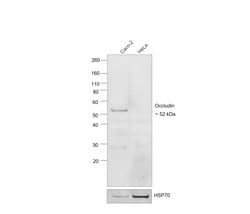
- Occludin is a 65 kDa protein that can exist in a variety of phosphorylated forms, ranging up to approximately 82 kDa
- Occludin is thought to be involved in regulating both the localization and the function of occludin
- Polyunsaturated fatty acids are known to up-regulate occludin expression, increasing the transendothelial cell resistance and reducing the cellular permeability to large molecules
- The level of occludin varies greatly depending on tissue; in brain tissue, occludin is highly and continuously expressed at cell-cell contact sites, whereas non-neural tissues show lower expression and discontinuous distribution
- Overall structural features of the occludin protein are highly conserved in all the species examined
- Under-expression of tight junction proteins, including occludin, is a key molecular abnormality responsible for the increased permeability of tumor endothelial tight junctions, which contributes to brain tumor edemas.