75-306-8882
CD68 Monoclonal Antibody (KP1), Alexa Fluor™ 514, Invitrogen™
Manufacturer: LIFE TECHNOLOGIES
Select a Size
| Pack Size | SKU | Availability | Price |
|---|---|---|---|
| Each of 1 | 75-306-8882-Each-of-1 | In Stock | ₹ 44,055.00 |
75-306-8882 - Each of 1
In Stock
Quantity
1
Base Price: ₹ 44,055.00
GST (18%): ₹ 7,929.90
Total Price: ₹ 51,984.90
Antigen
CD68
Classification
Monoclonal
Concentration
0.2 mg/mL
Formulation
PBS with 0.5% BSA, 10% proprietary stabilizer and 0.05% sodium azide; pH 7.2
Gene Accession No.
P34810
Host Species
Mouse
Quantity
100 μg
Primary or Secondary
Primary
Target Species
Human
Product Type
Antibody
Isotype
IgG1 κ
Applications
Immunohistochemistry (Paraffin)
Clone
KP1
Conjugate
Alexa Fluor 514
Gene
Cd68
Gene Alias
CD68; CD68 antigen; CD68 molecule; GP110; Lamp4; macrophage antigen CD68; macrosialin; Scard1; scavenger receptor class D, member 1; similar to CD68 antigen
Purification Method
Affinity chromatography
Regulatory Status
RUO
Gene ID (Entrez)
968
Content And Storage
4° C, store in dark, DO NOT FREEZE!
Form
Liquid
Related Products



Description
- CD68 Monoclonal antibody specifically detects CD68 in Human samples
- It is validated for Immunohistochemistry (Paraffin) Description: The KP1 antibody reacts with human CD68 which belongs to the sialomucin family and is closely related to the family of lysosomal-associated membrane proteins (lamps) and scavenger receptor
- CD68 is predominantly an intracellular protein, found mainly in the late endosomal compartment but can be detected in smaller amounts on the surface of mainly myeloid-derived cells; monocytes and macrophages, dendritic cells (and in some langerhan cells), neutrophils, basophils, mast cells, myeloid progenitor cells, and a subset of CD34+ hematopoietic bone marrow progenitor cells
- The function has not been fully elucidated but based on homology and structure, CD68 may play a role in antigen processing or presentation and protection of the lysosomal membrane from hydrolytic enzymes
- Reports have also shown expression in activated T cells, and about 40% of peripheral blood B-lymphocytes and 50% of all B-ALL
- The KP1 antibody has also been reported to stain fibroblasts which may be due to a conserved epitope rather than fibroblasts expressing CD68
- Applications Reported: This KP1 antibody has been reported for use in flow cytometric analysis, immunoprecipitation, western blotting, immunohistochemical staining of frozen tissue sections, and immunohistochemical staining of formalin-fixed paraffin embedded tissue sections
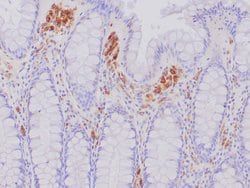
- Applications Tested: This KP1 antibody has been tested by immunohistochemistry of formalin-fixed paraffin embedded tissue using high pH antigen retrieval and can be used at 8 μg/mL
- It is recommended that the antibody be carefully titrated for optimal performance in the assay of interest
- Using conjugate solutions: Centrifuge the protein conjugate solution briefly in a microcentrifuge before use; add only the supernatant to the experiment
- This step will help eliminate any protein aggregates that may have formed during storage, thereby reducing nonspecific background staining.