89-021-178
CRYGD, Mouse, Clone: 4E12, Abnova™
Manufacturer: Abnova Corporation
Select a Size
| Pack Size | SKU | Availability | Price |
|---|---|---|---|
| Each of 1 | 89-021-178-Each-of-1 | In Stock | ₹ 42,898.00 |
89-021-178 - Each of 1
In Stock
Quantity
1
Base Price: ₹ 42,898.00
GST (18%): ₹ 7,721.64
Total Price: ₹ 50,619.64
Antigen
CRYGD
Classification
Monoclonal
Conjugate
Unconjugated
Formulation
PBS with no preservative; pH 7.4
Gene Accession No.
NM_006891
Gene Symbols
CRYGD
Immunogen
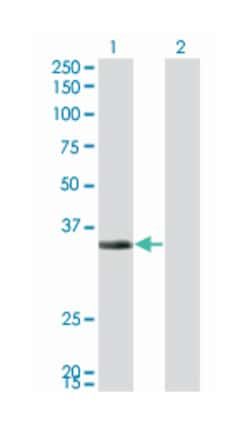
CRYGD (NP_008822, 75 a.a. ∼ 174 a.a) partial recombinant protein with GST tag. MW of the GST tag alone is 26 KDa.
Quantity
100 μg
Primary or Secondary
Primary
Target Species
Human
Product Type
Antibody
Isotype
IgG1 κ
Applications
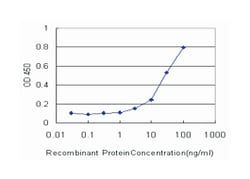
ELISA, Western Blot
Clone
4E12
Description
Mouse monoclonal antibody raised against a partial recombinant CRYGD.
Gene
CRYGD
Gene Alias
CACA/CCA3/CCP/CRYG4/cry-g-D
Host Species
Mouse
Purification Method
Affinity chromatography
Regulatory Status
RUO
Gene ID (Entrez)
1421
Content And Storage
Store at -20°C or lower. Aliquot to avoid repeated freezing and thawing.
Form
Liquid
Related Products
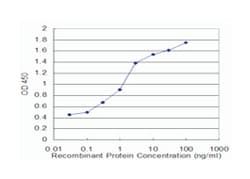
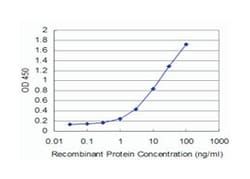
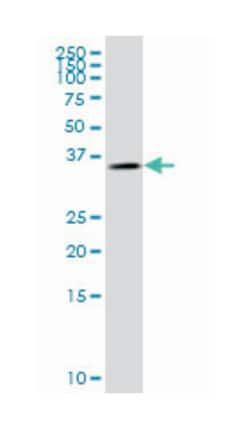
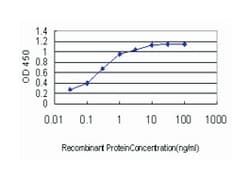

Description
- Crystallins are separated into two classes: taxon-specific, or enzyme, and ubiquitous
- The latter class constitutes the major proteins of vertebrate eye lens and maintains the transparency and refractive index of the lens
- Since lens central fiber cells lose their nuclei during development, these crystallins are made and then retained throughout life, making them extremely stable proteins
- Mammalian lens crystallins are divided into alpha, beta, and gamma families; beta and gamma crystallins are also considered as a superfamily
- Alpha and beta families are further divided into acidic and basic groups
- Seven protein regions exist in crystallins: four homologous motifs, a connecting peptide, and N- and C-terminal extensions
- Gamma-crystallins are a homogeneous group of highly symmetrical, monomeric proteins typically lacking connecting peptides and terminal extensions
- They are differentially regulated after early development
- Four gamma-crystallin genes (gamma-A through gamma-D) and three pseudogenes (gamma-E, gamma-F, gamma-G) are tandemly organized in a genomic segment as a gene cluster
- Whether due to aging or mutations in specific genes, gamma-crystallins have been involved in cataract formation
- [provided by RefSeq Sequence: SVRSCRLIPHSGSHRIRLYEREDYRGQMIEFTEDCSCLQDRFRFNEIHSLNVLEGSWVLYELSNYRGRQYLLMPGDYRRYQDWGATNARVGSLRRVIDFS