89-110-769
CDKN2D, Mouse, Clone: DCS-100, Abnova™
Manufacturer: Abnova Corporation
Select a Size
| Pack Size | SKU | Availability | Price |
|---|---|---|---|
| Each of 1 | 89-110-769-Each-of-1 | In Stock | ₹ 84,728.00 |
89-110-769 - Each of 1
In Stock
Quantity
1
Base Price: ₹ 84,728.00
GST (18%): ₹ 15,251.04
Total Price: ₹ 99,979.04
Antigen
CDKN2D
Classification
Monoclonal
Conjugate
Unconjugated
Dilution
The optimal working dilution should be determined by the end user.
Gene
CDKN2D
Gene Symbols
CDKN2D
Immunogen
Recombinant protein corresponding to full length human CDKN2D.
Regulatory Status
RUO
Gene ID (Entrez)
1032
Form
Liquid
Applications
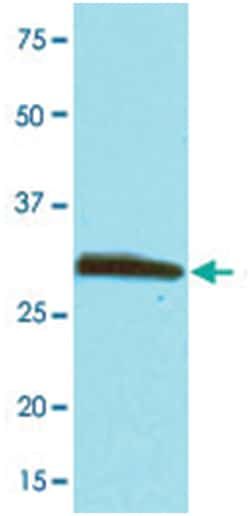
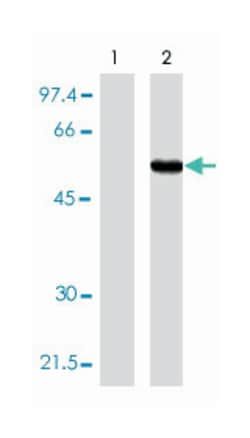
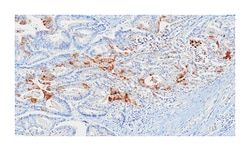
Immunohistochemistry, Immunoprecipitation, Western Blot
Clone
DCS-100
Description
Mouse monoclonal antibody raised against full length recombinant CDKN2D.
Formulation
In PBS (0.08% sodium azide)
Gene Alias
INK4D/p19/p19-INK4D
Host Species
Mouse
Quantity
100 μg
Primary or Secondary
Primary
Content And Storage
Store at -20°C.Aliquot to avoid repeated freezing and thawing.
Isotype
IgG1
Related Products

Description
- The protein encoded by this gene is a member of the INK4 family of cyclin-dependent kinase inhibitors
- This protein has been shown to form a stable complex with CDK4 or CDK6, and prevent the activation of the CDK kinases, thus function as a cell growth regulator that controls cell cycle G1 progression
- The abundance of the transcript of this gene was found to oscillate in a cell-cycle dependent manner with the lowest expression at mid G1 and a maximal expression during S phase
- The negative regulation of the cell cycle involved in this protein was shown to participate in repressing neuronal proliferation, as well as spermatogenesis
- Two alternatively spliced variants of this gene, which encode an identical protein, have been reported
- [provided by RefSeq