89-110-936
BEST1, Mouse, Clone: E6-6, Abnova™
Manufacturer: Abnova Corporation
Select a Size
| Pack Size | SKU | Availability | Price |
|---|---|---|---|
| Each of 1 | 89-110-936-Each-of-1 | In Stock | ₹ 98,167.00 |
89-110-936 - Each of 1
In Stock
Quantity
1
Base Price: ₹ 98,167.00
GST (18%): ₹ 17,670.06
Total Price: ₹ 1,15,837.06
Antigen
BEST1
Classification
Monoclonal
Conjugate
Unconjugated
Dilution
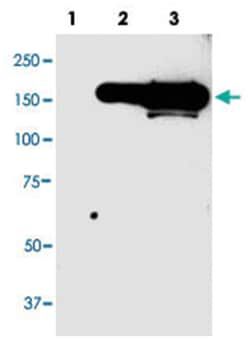
Western Blot (1:1000) The optimal working dilution should be determined by the end user.
Gene
BEST1
Gene Symbols
BEST1
Immunogen
A synthetic peptide (conjugated with KLH) corresponding to human BEST1.
Regulatory Status
RUO
Gene ID (Entrez)
7439
Target Species
Human, Porcine, Primate
Form
Liquid
Applications
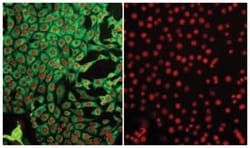
Immunofluorescence, Western Blot
Clone
E6-6
Description
Mouse monoclonal antibody raised against synthetic peptide of BEST1.
Formulation
In buffer containing 0.09% sodium azide
Gene Alias
ARB/BEST/BMD/TU15B/VMD2
Host Species
Mouse
Quantity
100 μL
Primary or Secondary
Primary
Test Specificity
This antibody recognizes a band at ∼68 KDa on Western Blot.
Content And Storage
Store at -20°C or -80°C.Aliquot to avoid repeated freezing and thawing.
Isotype
IgG1 κ
Related Products

Description
- This gene encodes a member of the bestrophin gene family
- This small gene family is characterized by proteins with a highly conserved N-terminus with four to six transmembrane domains
- Bestrophins may form chloride ion channels or may regulate voltage-gated L-type calcium-ion channels
- Bestrophins are generally believed to form calcium-activated chloride-ion channels in epithelial cells but they have also been shown to be highly permeable to bicarbonate ion transport in retinal tissue
- Mutations in this gene are responsible for juvenile-onset vitelliform macular dystrophy (VMD2), also known as Best macular dystrophy, in addition to adult-onset vitelliform macular dystrophy (AVMD) and other retinopathies
- Alternative splicing results in multiple variants encoding distinct isoforms Sequence: KDHMDPYWALENRDEAHS