FGF2 Sheep anti-Human, Mouse, Rat, Polyclonal Antibody, Abnova™
Manufacturer: Abnova Corporation
Select a Size
| Pack Size | SKU | Availability | Price |
|---|---|---|---|
| Each of 1 | 89-114-408-Each-of-1 | In Stock | ₹ 53,133.00 |
89-114-408 - Each of 1
In Stock
Quantity
1
Base Price: ₹ 53,133.00
GST (18%): ₹ 9,563.94
Total Price: ₹ 62,696.94
Antigen
FGF2
Classification
Polyclonal
Description
Sheep polyclonal antibody raised against full length recombinant FGF2.
Formulation
Lyophilized from PBS
Gene Accession No.
P09038
Gene Symbols
FGF2
Immunogen
Recombinant protein corresponding to full length human FGF2.
Regulatory Status
RUO
Gene ID (Entrez)
2247
Target Species
Human, Mouse, Rat
Form
Lyophilized
Applications
Immunohistochemistry (Frozen)
Conjugate
Unconjugated
Dilution
Immunohistochemistry (1 ug/mL) The optimal working dilution should be determined by the end user.
Gene
FGF2
Gene Alias
BFGF/FGFB/HBGF-2
Host Species
Sheep
Quantity
100 μg
Primary or Secondary
Primary
Test Specificity
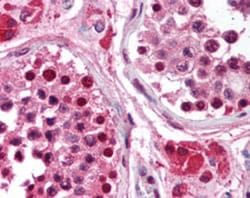
A high level of specificity for bFGF was shown by immunohistochemistry for this antiserum.
Content And Storage
Store at 4°C on dry atmosphere. After reconstitution with deionized water store at -20°C or lower. Aliquot to avoid repeated freezing and thawing.
Related Products


Description
- The protein encoded by this gene is a member of the fibroblast growth factor (FGF) family
- FGF family members bind heparin and possess broad mitogenic and angiogenic activities
- This protein has been implicated in diverse biological processes, such as limb and nervous system development, wound healing, and tumor growth
- The mRNA for this gene contains multiple polyadenylation sites, and is alternatively translated from non-AUG (CUG) and AUG initiation codons, resulting in five different isoforms with distinct properties
- The CUG-initiated isoforms are localized in the nucleus and are responsible for the intracrine effect, whereas, the AUG-initiated form is mostly cytosolic and is responsible for the paracrine and autocrine effects of this FGF
- [provided by RefSeq