89-115-862
ALOX5 Rabbit anti-Human, Mouse, Polyclonal Antibody, Abnova™
Manufacturer: Abnova Corporation
Select a Size
| Pack Size | SKU | Availability | Price |
|---|---|---|---|
| Each of 1 | 89-115-862-Each-of-1 | In Stock | ₹ 1,09,381.00 |
89-115-862 - Each of 1
In Stock
Quantity
1
Base Price: ₹ 1,09,381.00
GST (18%): ₹ 19,688.58
Total Price: ₹ 1,29,069.58
Antigen
ALOX5
Classification
Polyclonal
Description
Rabbit polyclonal antibody raised against synthetic peptide of ALOX5.
Formulation
In PBS (30% glycerol, 0.09% sodium azide)
Gene Accession No.
P09917
Gene Symbols
ALOX5
Immunogen
A synthetic peptide corresponding to amino acids 100-200 of human ALOX5.
Regulatory Status
RUO
Gene ID (Entrez)
240
Content And Storage
Store at -20°C or -80°C.Aliquot to avoid repeated freezing and thawing.
Applications
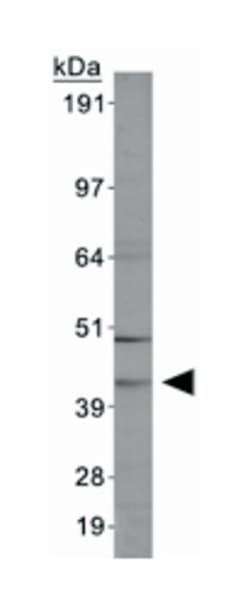
Western Blot
Conjugate
Unconjugated
Dilution
Western Blot (1:500-1:1000) The optimal working dilution should be determined by the end user.
Gene
ALOX5
Gene Alias
5-LO/5-LOX/5LPG/LOG5/MGC163204
Host Species
Rabbit
Quantity
100 μL
Primary or Secondary
Primary
Target Species
Human, Mouse
Form
Liquid
Related Products

Description
- This gene encodes a member of the lipoxygenase gene family and plays a dual role in the synthesis of leukotrienes from arachidonic acid
- The encoded protein, which is expressed specifically in bone marrow-derived cells, catalyzes the conversion of arachidonic acid to 5(S)-hydroperoxy-6-trans-8,11,14-cis-eicosatetraenoic acid, and further to the allylic epoxide 5(S)-trans-7,9-trans-11,14-cis-eicosatetrenoic acid (leukotriene A4)
- Leukotrienes are important mediators of a number of inflammatory and allergic conditions
- Mutations in the promoter region of this gene lead to a diminished response to antileukotriene drugs used in the treatment of asthma and may also be associated with atherosclerosis and several cancers
- Alternatively spliced transcript variants have been observed, but their full-length nature has not been determined
- [provided by RefSeq