AKAP1, Rabbit, Polyclonal Antibody, Abnova™
Manufacturer: Abnova Corporation
Select a Size
| Pack Size | SKU | Availability | Price |
|---|---|---|---|
| Each of 1 | 89-126-630-Each-of-1 | In Stock | ₹ 70,488.00 |
89-126-630 - Each of 1
In Stock
Quantity
1
Base Price: ₹ 70,488.00
GST (18%): ₹ 12,687.84
Total Price: ₹ 83,175.84
Antigen
AKAP1
Classification
Polyclonal
Conjugate
Unconjugated
Dilution
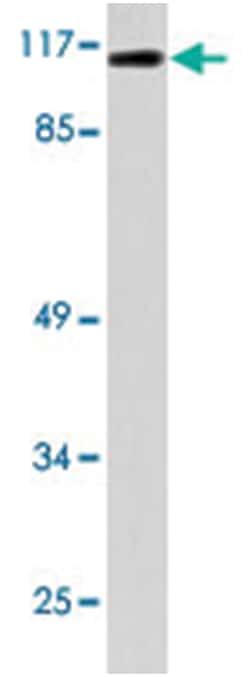
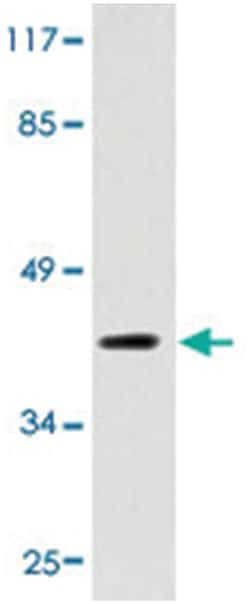
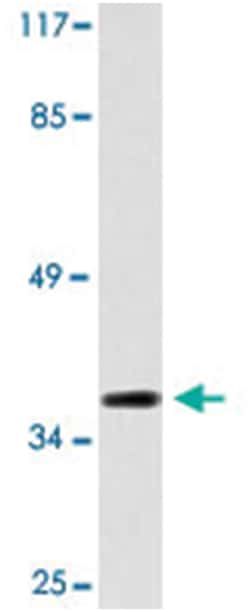
Western Blot (1:500-1:1000) Immunohistochemistry (1:50-1:200) Immunofluorescence (1:50-1:200) The optimal working dilution should be determined by the end user.
Gene
AKAP1
Gene Symbols
AKAP1
Immunogen
A synthetic peptide corresponding to AKAP1.
Quantity
100 μL
Primary or Secondary
Primary
Test Specificity
AKAP1 polyclonal antibody detects endogenous levels of AKAP1 protein.
Content And Storage
Store at 4°C. For long term storage store at -20°C.Aliquot to avoid repeated freezing and thawing.
Applications
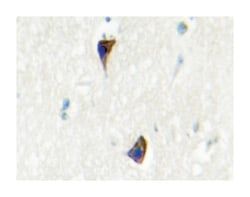
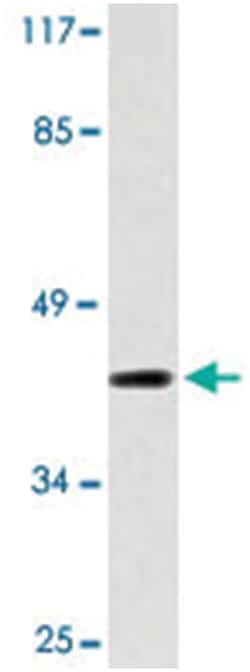
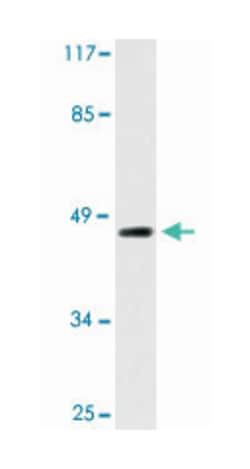
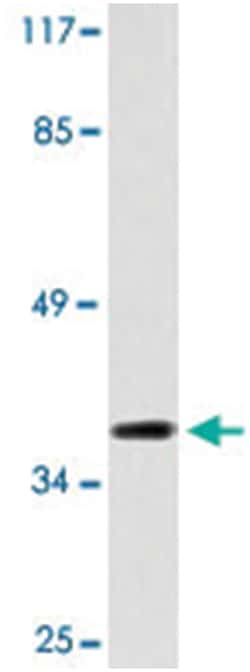
Immunofluorescence, Immunohistochemistry (PFA fixed), Western Blot
Concentration
1 mg/mL
Description
Rabbit polyclonal antibody raised against synthetic peptide of AKAP1.
Formulation
In PBS, pH 7.2 (0.05% sodium azide)
Gene Alias
AKAP/AKAP121/AKAP149/AKAP84/D-AKAP1/MGC1807/PRKA1/SAKAP84
Host Species
Rabbit
Purification Method
Antigen affinity purification
Regulatory Status
RUO
Gene ID (Entrez)
8165
Target Species
Human
Form
Liquid
Related Products
Description
- The A-kinase anchor proteins (AKAPs) are a group of structurally diverse proteins, which have the common function of binding to the regulatory subunit of protein kinase A (PKA) and confining the holoenzyme to discrete locations within the cell
- This gene encodes a member of the AKAP family
- The encoded protein binds to type I and type II regulatory subunits of PKA and anchors them to the mitochondrion
- This protein is speculated to be involved in the cAMP-dependent signal transduction pathway and in directing RNA to a specific cellular compartment
- [provided by RefSeq