89-133-073
UCP2, Goat, Polyclonal Antibody, Abnova™
Manufacturer: Abnova Corporation
Select a Size
| Pack Size | SKU | Availability | Price |
|---|---|---|---|
| Each of 1 | 89-133-073-Each-of-1 | In Stock | ₹ 70,399.00 |
89-133-073 - Each of 1
In Stock
Quantity
1
Base Price: ₹ 70,399.00
GST (18%): ₹ 12,671.82
Total Price: ₹ 83,070.82
Antigen
UCP2
Classification
Polyclonal
Conjugate
Unconjugated
Dilution
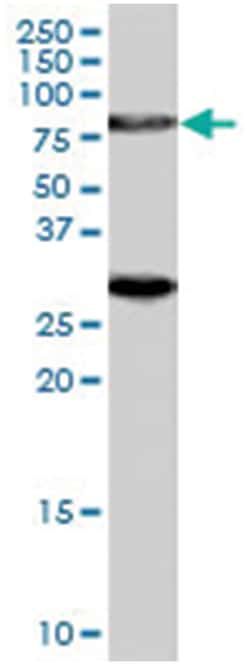
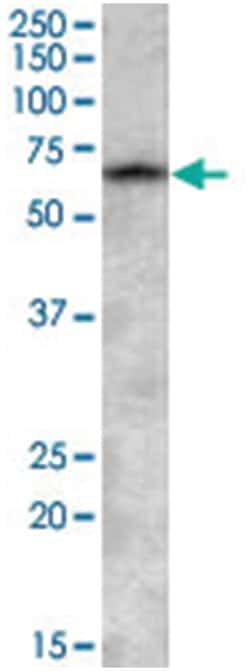
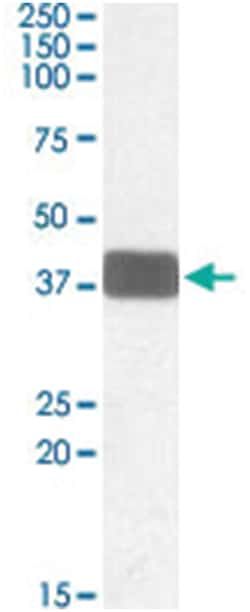
ELISA (1:4000) Western Blot (0.2-1 ug/mL) The optimal working dilution should be determined by the end user.
Gene
UCP2
Gene Symbols
UCP2
Immunogen
A synthetic peptide corresponding to internal region of human UCP2.
Quantity
100 μg
Primary or Secondary
Primary
Target Species
Human
Form
Liquid
Applications
ELISA, Western Blot
Concentration
0.5 mg/mL
Description
Goat polyclonal antibody raised against synthetic peptide of UCP2.
Formulation
In Tris saline, pH 7.3 (0.5% BSA, 0.02% sodium azide)
Gene Alias
BMIQ4/SLC25A8/UCPH
Host Species
Goat
Purification Method
Antigen affinity purification
Regulatory Status
RUO
Gene ID (Entrez)
7351
Content And Storage
Store at -20°C.Aliquot to avoid repeated freezing and thawing.
Related Products

Description
- Mitochondrial uncoupling proteins (UCP) are members of the larger family of mitochondrial anion carrier proteins (MACP)
- UCPs separate oxidative phosphorylation from ATP synthesis with energy dissipated as heat, also referred to as the mitochondrial proton leak
- UCPs facilitate the transfer of anions from the inner to the outer mitochondrial membrane and the return transfer of protons from the outer to the inner mitochondrial membrane
- They also reduce the mitochondrial membrane potential in mammalian cells
- Tissue specificity occurs for the different UCPs and the exact methods of how UCPs transfer H+/OH- are not known
- UCPs contain the three homologous protein domains of MACPs
- This gene is expressed in many tissues, with the greatest expression in skeletal muscle
- It is thought to play a role in nonshivering thermogenesis, obesity and diabetes
- Chromosomal order is 5'-UCP3-UCP2-3'
- [provided by RefSeq] Sequence: C-DSVKQFYTKGSEH