89-333-165
CASP3 Mouse anti-Human, Clone:3D4D7, Abnova™
Manufacturer: Abnova Corporation
Select a Size
| Pack Size | SKU | Availability | Price |
|---|---|---|---|
| Each of 1 | 89-333-165-Each-of-1 | In Stock | ₹ 60,787.00 |
89-333-165 - Each of 1
In Stock
Quantity
1
Base Price: ₹ 60,787.00
GST (18%): ₹ 10,941.66
Total Price: ₹ 71,728.66
Antigen
CASP3
Classification
Monoclonal
Conjugate
Unconjugated
Dilution
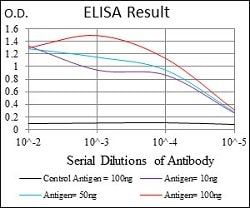
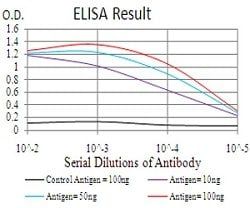
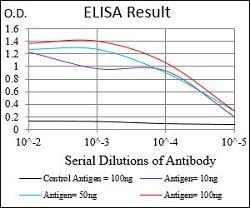
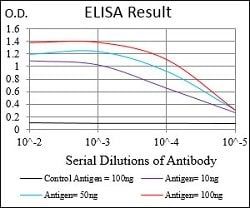
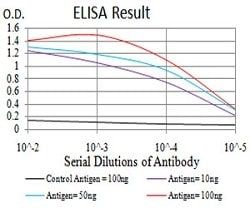
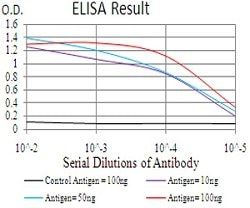
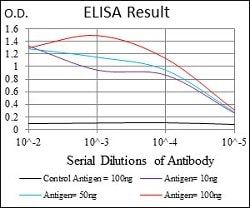
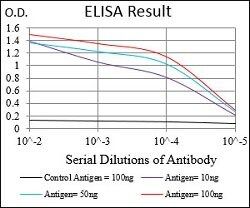
ELISA (1:10000)Western Blot (1:500-1:2000)ImmunohistochemistryImmunocytochemistryFlow Cytometry (1:200-1:400)The optimal working dilution should be determined by the end user.
Gene
CASP3
Host Species
Mouse
Quantity
100 μg
Target Species
Human
Product Type
Antibody
Isotype
IgG1
Applications
ELISA, Flow Cytometry
Clone
3D4D7
Description
caspase 3, apoptosis-related cysteine peptidase
Formulation
In PBS (0.05% sodium azide)
Gene Alias
CPP32, CPP32B, SCA-1
Immunogen
Recombinant protein corresponding to amino acid 29-175 of human CASP3 fromE. coli.
Gene ID (Entrez)
836
Content And Storage
Store at 4°C. For long term storage store at -20°C.Aliquot to avoid repeated freezing and thawing.
Form
Liquid
Related Products
Description
- This gene encodes a protein which is a member of the cysteine-aspartic acid protease (caspase) family
- Sequential activation of caspases plays a central role in the execution-phase of cell apoptosis
- Caspases exist as inactive proenzymes which undergo proteolytic processing at conserved aspartic residues to produce two subunits, large and small, that dimerize to form the active enzyme
- This protein cleaves and activates caspases 6, 7 and 9, and the protein itself is processed by caspases 8, 9 and 10
- It is the predominant caspase involved in the cleavage of amyloid-beta 4A precursor protein, which is associated with neuronal death in Alzheimer′s disease
- Alternative splicing of this gene results in two transcript variants that encode the same protein
- [provided by RefSeq]