CDKN1B Mouse anti-Human, Rat, Clone: KIP1/769, Abnova™
Manufacturer: Abnova Corporation
Select a Size
| Pack Size | SKU | Availability | Price |
|---|---|---|---|
| Each of 1 | 89-933-932-Each-of-1 | In Stock | ₹ 67,017.00 |
89-933-932 - Each of 1
In Stock
Quantity
1
Base Price: ₹ 67,017.00
GST (18%): ₹ 12,063.06
Total Price: ₹ 79,080.06
Antigen
CDKN1B
Classification
Monoclonal
Conjugate
Unconjugated
Dilution
Flow Cytometry (0.5-1 ug/106cells in 0.1 mL) Immunofluorescence (0.5-1 ug/mL) Immunohistochemistry (Formalin/PFA-fixed paraffin-embedded sections) (0.25-0.5 ug/mL) Western Blot (0.5-1 ug/mL) The optimal working dilution should be d
Gene Alias
CDKN4/KIP1/MEN1B/MEN4/P27KIP1
Host Species
Mouse
Purification Method
Protein A/G purification
Regulatory Status
RUO
Gene ID (Entrez)
1027
Target Species
Human, Rat
Form
Liquid
Applications
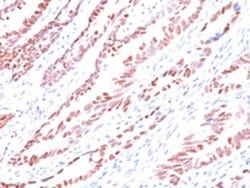
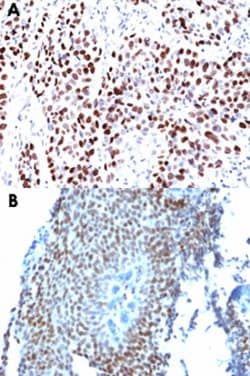
Flow Cytometry, Immunofluorescence, Immunohistochemistry (PFA fixed), Western Blot
Clone
KIP1/769
Description
Mouse monoclonal antibody raised against full length recombinant human CDKN1B.
Formulation
In 10mM PBS.
Gene Symbols
CDKN1B
Immunogen
Recombinant protein corresponding to full length human CDKN1B.
Quantity
100 μg
Primary or Secondary
Primary
Test Specificity
This monoclonal antibody is highly specific to CDKN1B and shows no cross-reaction with other closely related mitotic inhibitors.
Content And Storage
Store at -20 to -80°C.Aliquot to avoid repeated freezing and thawing.
Isotype
IgG1 κ
Related Products

Description
- Description This gene encodes a cyclin-dependent kinase inhibitor, which shares a limited similarity with CDK inhibitor CDKN1A/p21
- The encoded protein binds to and prevents the activation of cyclin E-CDK2 or cyclin D-CDK4 complexes, and thus controls the cell cycle progression at G1
- The degradation of this protein, which is triggered by its CDK dependent phosphorylation and subsequent ubiquitination by SCF complexes, is required for the cellular transition from quiescence to the proliferative state
- [provided by RefSeq]