TACC3 Recombinant Rabbit Monoclonal Antibody (10G7), Invitrogen™
Manufacturer: Thermo Scientific
Select a Size
| Pack Size | SKU | Availability | Price |
|---|---|---|---|
| Each of 1 | FEMA549937-Each-of-1 | In Stock | ₹ 37,202.00 |
FEMA549937 - Each of 1
In Stock
Quantity
1
Base Price: ₹ 37,202.00
GST (18%): ₹ 6,696.36
Total Price: ₹ 43,898.36
Antigen
TACC3
Classification
Recombinant Monoclonal
Concentration
1.15 mg/mL
Formulation
PBS with 50% glycerol and 0.02% sodium azide, pH 7.4
Gene Accession No.
Q9Y6A5
Gene Symbols
TACC3
Immunogen
A synthesized peptide derived from human TACC3
Quantity
100 μL
Primary or Secondary
Primary
Target Species
Human
Form
Liquid
Applications
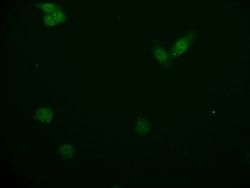
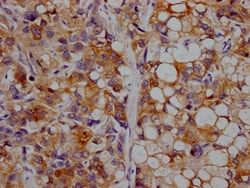
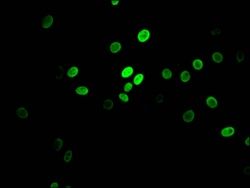
ELISA, Immunohistochemistry (Paraffin), Western Blot
Clone
10G7
Conjugate
Unconjugated
Gene
TACC3
Gene Alias
Aint, Arnt interacting protein, ARNT-interacting protein, C86661, ERIC1, ERIC-1, Tacc3, transforming acidic coiled coil 3, transforming acidic coiled-coil containing protein 3, transforming acidic coiled-coil-containing protein 3, transforming, acidic coiled-coil containing protein 3
Host Species
Rabbit
Purification Method
Affinity chromatography
Regulatory Status
RUO
Gene ID (Entrez)
10460
Content And Storage
-20°C or -80°C if preferred
Isotype
IgG
Related Products

Description
- TACC1 is located on 8p11 chromosomal region that is amplified in approximately 15% of all breast tumor samples
- The short arm of chromosome 8 also contains FGFR1 whose expression is enhanced in most breast cancer tumors
- TACC family members, TACC1, TACC2, and TACC3, map very closely to the corresponding FGFR1, FGFR2, FGFR3 genes on chromosomes 4,8, and 10
- Subsequently, since they are phylogenetically related, it is proposed that TACC and FGFR have similar roles in cell growth and differentiation
- Also, TACC1 contains a conserved C-terminal region as in the Drosophila homolog, D-TACC
- It has been shown that D-TACC is necessary for normal spindle function, and the mammalian TACC proteins appears to interact with centrosomes and microtubules in a similar manner.