NFATC2 Monoclonal Antibody (25A10.D6.D2), Invitrogen™
Manufacturer: Thermo Scientific
Select a Size
| Pack Size | SKU | Availability | Price |
|---|---|---|---|
| Each of 1 | MA1025-Each-of-1 | In Stock | ₹ 51,709.00 |
MA1025 - Each of 1
In Stock
Quantity
1
Base Price: ₹ 51,709.00
GST (18%): ₹ 9,307.62
Total Price: ₹ 61,016.62
Antigen
NFATC2
Classification
Monoclonal
Concentration
1 mg/mL
Formulation
PBS with 0.05% sodium azide
Gene Accession No.
Q13469, Q60591
Gene Symbols
NFATC2
Immunogen
Synthetic peptide corresponding to residues A(51) I S S P S G L A Y P D D V L D Y G L(69) of mouse NFATc2-A, B and C isoforms.
Quantity
100 μg
Primary or Secondary
Primary
Target Species
Human, Mouse, Rat
Product Type
Antibody
Isotype
IgG1
Applications
ChIP Assay, Gel Shift, Immunocytochemistry, Immunohistochemistry (Frozen), Immunohistochemistry (Paraffin), Immunoprecipitation, Western Blot
Clone
25A10.D6.D2
Conjugate
Unconjugated
Gene
NFATC2
Gene Alias
AI607462; IB-IXL; KIAA0611; NFAT pre-existing s; NFAT pre-existing subunit; NFAT transcription complex, preexisting component; Nfat1; NFAT1-D; Nfatc2; NF-ATc2; Nfatp; NF-ATp; nuclear factor of activated T cells, cytoplasmic, calcineurin dependent 2; nuclear factor of activated T-cells 2; nuclear factor of activated T-cells, cytoplasmic 2; nuclear factor of activated T-cells, cytoplasmic, calcineurin-dependent 2; nuclear factor of activated T-cells, preexisting component; OTTHUMP00000031291; preexisting nuclear factor of activated T-cells 2; T cell transcription factor NFAT1; T-cell transcription factor NFAT1
Host Species
Mouse
Purification Method
Protein G
Regulatory Status
RUO
Gene ID (Entrez)
18019, 311658, 4773
Content And Storage
-20° C, Avoid Freeze/Thaw Cycles
Form
Liquid
Related Products




Description
- MA1-025 detects NFATc2 (NFAT1) from mouse, rat and human tissues
- This antibody does not cross react with NFAT2 (NFATc, NFATc1)
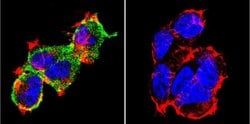
- MA1-025 has been successfully used in Western blot, ChIP, immunocytochemistry, immunoprecipitation, immunofluorescence, immunohistochemistry (frozen & paraffin), and gel shift procedures
- By Western blot, this antibody detects an ∽140 kDa protein representing phosphorylated NFAT1 in resting immune cells, and an ∽120 kDa protein in stimulated cells that represents fully-dephosphorylated NFAT1
- The MA1-025 immunogen is a synthetic peptide corresponding to residues A(51) I S S P S G L A Y P D D V L D Y G L(69) of mouse NFAT1-A, B and C isoforms
- The sequence of this N-terminal peptide is ∽70% homologous with human NFAT1
- Antibodies to this protein were previously sold as part of a Thermo Scientific Cellomics High Content Screening Kit
- This replacement antibody is now recommended for researchers who need an antibody for high content cell-based assays
- It has been thoroughly tested and validated for cellular immunofluorescence (IF) applications
- Further optimization, including the selection of the most appropriate fluorescent DyLight conjugated secondary antibody, may have to be performed for your high content assay
- MA1-025 can be used with blocking peptide PEP-062
- The nuclear factor of activated T-cells (NFAT) transcription complex is required for the expression of a group of proteins that collectively regulate the immune response
- Four NFAT proteins, encoded on separate genes and expressed as several splice variants, have been described: NFAT1 (also known as NFATp or NFATc2), NFAT2 (NFATc or NFATc1), NFAT3, and NFAT4 (NFATx or NFATc3)
- These proteins show a low level of sequence similarity with the Dorsal/Rel/NFkB family of transcription factors
- Another NFAT-related protein termed NFAT5 differs from isoforms 1-4 in that it lacks many of the Fos/Jun contact sites observed in its predecessors and its subcellular localization is not calcineurin-dependent.