OP16L100UG
MilliporeSigma™ anti-c-ErbB2/c-Neu Clone: 7.16.4,
Manufacturer: MilliporeSigma™
Select a Size
| Pack Size | SKU | Availability | Price |
|---|---|---|---|
| Each of 1 | OP16L100UG-Each-of-1 | In Stock | ₹ 48,229.10 |
OP16L100UG - Each of 1
In Stock
Quantity
1
Base Price: ₹ 48,229.10
GST (18%): ₹ 8,681.238
Total Price: ₹ 56,910.338
Antigen
c-ErbB2/c-Neu
Classification
Monoclonal
Conjugate
Unconjugated
Host Species
Mouse
Quantity
100 μg
Primary or Secondary
Primary
Target Species
Human, Rat
Form
Purified
Applications
Immunoblot, Immunocytochemistry, Immunohistochemistry (Frozen), Immunoprecipitation
Clone
7.16.4
Formulation
In 50mM sodium phosphate buffer, 0.2% gelatin, pH 7.5.
Immunogen
B104-1-1 cells overexpressing rat c-ErbB2/c-Neu
Regulatory Status
RUO
Test Specificity
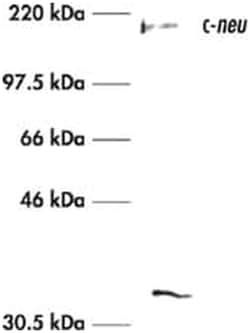
Recognizes the ∽185kDa c-ErbB2/c-Neu protein in overexpressing B104-1-1 cells.
Content And Storage
2°C to 8°C
Isotype
IgG2a
Related Products

Description
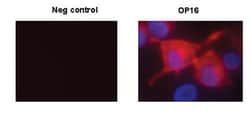
- Specifically detects c-ErbB2/c-Neu Clone: 7.16.4 in Human, Rat samples, and it is validated for Immunocytochemistry, Immunohistochemistry (Frozen), Immunoprecipitation, Immuno Blotting Amplification of the human proto-oncogene c- neu occurs in approximately 30% of breast carcinomas and the amplification maybe a useful predictor of disease prognosis
- Gene amplification and the resulting overexpression of proto-oncogene encoded proteins is thought to transform cells by chronically stimulating signal transduction pathways and in model systems overexpression of human c- neu induces cellular transformation
- In the rat model system, a point mutation has been located within the transmembrane domain of the c- neu oncogene
- neu (from neu roglioblastomas) is also referred to as erbB-2 (from er ythro b lastosis virus) and HER2 (for H uman E pidermal Growth Factor R eceptor) and was the second of four members of the EGF receptor family to be described.