Phospho-BIK (Thr33) Polyclonal Antibody, Invitrogen™
Manufacturer: Thermo Scientific
Select a Size
| Pack Size | SKU | Availability | Price |
|---|---|---|---|
| Each of 1 | PA540170-Each-of-1 | In Stock | ₹ 45,968.50 |
PA540170 - Each of 1
In Stock
Quantity
1
Base Price: ₹ 45,968.50
GST (18%): ₹ 8,274.33
Total Price: ₹ 54,242.83
Antigen
Phospho-BIK (Thr33)
Classification
Polyclonal
Conjugate
Unconjugated
Gene
BIK
Gene Alias
apoptosis inducer NBK; apoptosis-inducing NBK; BBC1; BCL2 interacting killer; bcl-2-interacting killer; BCL2-interacting killer; BCL2-interacting killer (apoptosis-inducing); bhikhari; BIK; Bik-like killer protein; Biklk; BIP 1; BIP1; Blk; BP 4; BP4; cb 60; natural born killer; NBK
Host Species
Rabbit
Purification Method
Antigen affinity chromatography
Regulatory Status
RUO
Gene ID (Entrez)
638
Content And Storage
-20° C, Avoid Freeze/Thaw Cycles
Form
Liquid
Applications
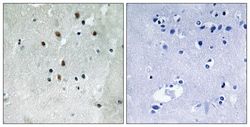
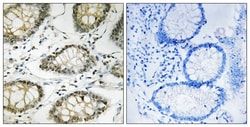
Immunohistochemistry (Paraffin), Western Blot
Concentration
1 mg/mL
Formulation
PBS with 50% glycerol and 0.02% sodium azide; pH 7.4
Gene Accession No.
Q13323
Gene Symbols
BIK
Immunogen
Peptide sequence around phosphorylation site of threonine 33 (G-M-T(p)-D-S) derived from Human BIK.
Quantity
100 μL
Primary or Secondary
Primary
Target Species
Human
Product Type
Antibody
Isotype
IgG
Related Products

Description
- The Bik protein is known to interact with cellular and viral survival-promoting proteins, such as BCL2 and the Epstein-Barr virus in order to enhance programmed cell death
- Because its activity is suppressed in the presence of survival-promoting proteins, this protein is suggested as a likely target for antiapoptotic proteins
- This protein shares a critical BH3 domain with other death-promoting proteins, BAX and BAK.