PA550415
FASTKD3 Polyclonal Antibody, Invitrogen™
Manufacturer: Thermo Scientific
Select a Size
| Pack Size | SKU | Availability | Price |
|---|---|---|---|
| Each of 1 | PA550415-Each-of-1 | In Stock | ₹ 46,502.50 |
PA550415 - Each of 1
In Stock
Quantity
1
Base Price: ₹ 46,502.50
GST (18%): ₹ 8,370.45
Total Price: ₹ 54,872.95
Antigen
FASTKD3
Classification
Polyclonal
Conjugate
Unconjugated
Gene
FASTKD3
Gene Alias
2310010B21Rik; AW048587; FAKD3; FAST kinase domain-containing protein 3; FAST kinase domain-containing protein 3, mitochondrial; FAST kinase domains 3; FASTKD3; FLJ23274; RGD1309729
Host Species
Rabbit
Purification Method
Antigen affinity chromatography
Regulatory Status
RUO
Gene ID (Entrez)
79072
Content And Storage
-20°C
Form
Liquid
Applications
Western Blot
Concentration
0.7 mg/mL
Formulation
PBS with 40% glycerol and 0.05% sodium azide; pH 7.4
Gene Accession No.
Q14CZ7
Gene Symbols
FASTKD3
Immunogen
Fusion protein corresponding to a region derived from internal residues of human FAST kinase domains 3
Quantity
100 μL
Primary or Secondary
Primary
Target Species
Human
Product Type
Antibody
Isotype
IgG
Related Products


Description
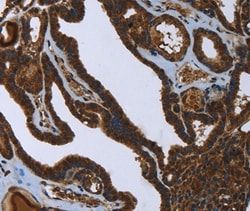
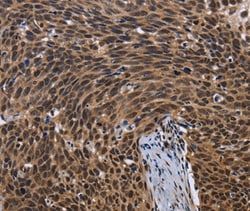
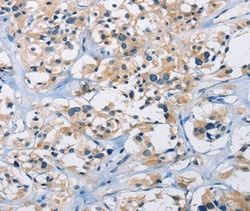
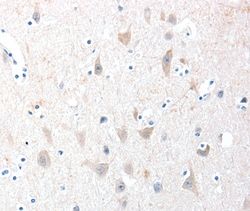
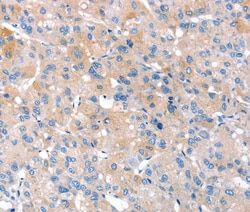
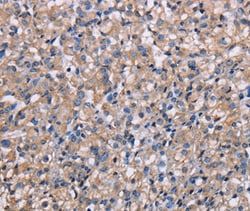
- The antibody detects endogenous levels of total FASTKD3 protein
- This gene encodes a member of a small family of Fas-activated serine/threonine kinase domain (FASTKD) containing proteins that share an amino terminal mitochondrial targeting domain and multiple carboxy terminal FAST domains as well as a putative RNA-binding RAP domain
- The members of this family are ubiquitously expressed and are generally most abundant in mitochondria-enriched tissues such as heart, skeletal muscle and brown-adipose tissue
- Some members of this protein family may play a role in apoptosis
- The protein encoded by this gene interacts with components of the mitochondrial respiratory and translation networks
- A pseudogene of this gene is also present on chromosome 5
- Alternative splicing results in multiple transcript variants.