Urotensin II Receptor Polyclonal Antibody, Invitrogen™
Manufacturer: Thermo Scientific
Select a Size
| Pack Size | SKU | Availability | Price |
|---|---|---|---|
| Each of 1 | PA550506-Each-of-1 | In Stock | ₹ 46,502.50 |
PA550506 - Each of 1
In Stock
Quantity
1
Base Price: ₹ 46,502.50
GST (18%): ₹ 8,370.45
Total Price: ₹ 54,872.95
Antigen
Urotensin II Receptor
Classification
Polyclonal
Conjugate
Unconjugated
Gene
UTS2R
Gene Alias
G protein-coupled receptor 14; GPR14; G-protein coupled receptor 14; G-protein coupled sensory epithelial neuropeptide-like receptor; putative G protein-coupled receptor (SENR); Senr; Uiir; Uii-r; Uii-r1a; UII-receptor; UR2R; UR-2-R; UR-II-R; urotensin 2 receptor; urotensin II receptor; Urotensin-2 receptor; UT-II; UTIIR; UTR; UTR2; Uts2r
Host Species
Rabbit
Purification Method
Antigen affinity chromatography
Regulatory Status
RUO
Gene ID (Entrez)
2837
Content And Storage
-20°C
Form
Liquid
Applications
Western Blot
Concentration
0.8 mg/mL
Formulation
PBS with 40% glycerol and 0.05% sodium azide; pH 7.4
Gene Accession No.
Q9UKP6
Gene Symbols
UTS2R
Immunogen
Synthetic peptide corresponding to a region derived from internal residues of human urotensin 2 receptor
Quantity
100 μL
Primary or Secondary
Primary
Target Species
Human
Product Type
Antibody
Isotype
IgG
Related Products




Description
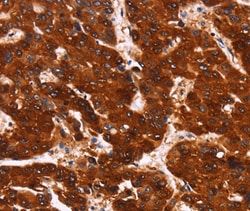
- The antibody detects endogenous levels of total UTS2R / GPR14 protein
- The Urotensin-II receptor has been reported to be expressed at high levels in the heart and pancreas and also in artery and smooth muscle
- Low transcript levels have been identified in brain, particularly in thalamus, and superior occipital gyrus
- G-protein Coupled Receptors (GPCRs) comprise one of the largest families of signaling molecules with more than a thousand members currently predicted to exist
- All GPCRs share a structural motif consisting of seven membrane-spanning helices, and exist in both active and inactive forms
- An array of activating ligands participate in the conformation of GPCRs which leads to signaling via G-proteins and downstream effectors
- Ongoing studies have also shown the vast series of reactions which participate in the negative regulation of GPCRs
- This turn-off activity has tremendous implications for the physiological action of the cell, and continues to drive pharmacological research for new drug candidates
- Two blockbuster drugs which have been developed as GPCR-targeted pharmaceuticals are Zyprexa (Eli Lilly) and Claritin (Schering-Plough) which have multi-billion dollar shares of the mental health and allergy markets, respectively.