PC116100UG
MilliporeSigma™ anti-ATM (Ab-3) (819-844), Polyclonal
Manufacturer: MilliporeSigma™
Select a Size
| Pack Size | SKU | Availability | Price |
|---|---|---|---|
| Each of 1 | PC116100UG-Each-of-1 | In Stock | ₹ 40,762.00 |
PC116100UG - Each of 1
In Stock
Quantity
1
Base Price: ₹ 40,762.00
GST (18%): ₹ 7,337.16
Total Price: ₹ 48,099.16
Antigen
ATM (819-844)
Classification
Polyclonal
Formulation
In 50mM sodium phosphate buffer, 0.2% gelatin.
Immunogen
a synthetic peptide (CKSLASFIKKPFDRGEVESMEDDTNG) corresponding to amino acids 819-844 of human ATM
Regulatory Status
RUO
Test Specificity
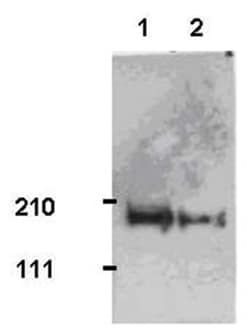
Recognizes the ∽350kDa ATM protein in Daudi and HeLa cells.
Content And Storage
2°C to 8°C
Isotype
IgG
Applications
Immunoprecipitation
Conjugate
Unconjugated
Host Species
Rabbit
Quantity
100 μg
Primary or Secondary
Primary
Target Species
Human
Form
Purified
Related Products


Description
- Specifically detects ATM (819-844) Clone: in Human samples, and it is validated for Immunoprecipitation Ataxia telangiectasia (AT) is an autosomal recessive disease characterized by cerebellar degeneration, an uneven gait (ataxia), neuromotor deterioration, the appearance of dilated blood vessels (telangiectasia) in the conjunctiva of the eyes and skin, and a large increase in cancer susceptibility
- Cells of AT patients have increased sensitivity to ionizing radiation, defects in G1 and G2 of the cell cycle, and are unable to effect a normal p53-dependent G1 arrest due to failure to properly induce WAF1
- Identification of the gene in AT patients showed that the disease is caused by a mutation of a single gene called ATM
- Cloning of the ATM cDNA indicates that it contains a large open reading frame and encodes a putative protein of 3056 amino acids
- The C-terminal region has extensive homology to the catalytic domains of phosphatidylinositol 3-kinases (PI3 kinases)
- A family of ATM-related genes has been identifed suggesting a role for these proteins in signal transduction and cell cycle regulation
- ATM may be a key regulator of p53-mediated apoptosis.