Phospho-IkB alpha (Ser32) Recombinant Rabbit Monoclonal Antibody (6H4L6), Invitrogen™
Manufacturer: Thermo Scientific
Select a Size
| Pack Size | SKU | Availability | Price |
|---|---|---|---|
| Each of 1 | PI701271-Each-of-1 | In Stock | ₹ 57,138.00 |
PI701271 - Each of 1
In Stock
Quantity
1
Base Price: ₹ 57,138.00
GST (18%): ₹ 10,284.84
Total Price: ₹ 67,422.84
Antigen
Phospho-IkB alpha (Ser32)
Classification
Recombinant Monoclonal
Concentration
0.5 mg/mL
Formulation
PBS with 0.09% sodium azide
Gene Accession No.
P25963
Gene Symbols
NFKBIA
Immunogen
Phosphopeptide corresponding to amino acids 27-36 of human I K B-Alpha [pS32]
Quantity
100 μg
Primary or Secondary
Primary
Target Species
Human
Product Type
Antibody
Isotype
IgG
Applications
Western Blot
Clone
6H4L6
Conjugate
Unconjugated
Gene
NFKBIA
Gene Alias
AI462015; ECI-6; ECI-6/IKBA; I kappa B-alpha; I(Kappa)B(alpha); I79_018146; IkappaB alpha; IkappaBalpha; I-kappaBalpha; I-kappa-B-alpha; Ikba; IKBalpha; IKB-alpha; Inhibitor of nuclear factor of kappa light chain gene enhancer in B-cells alpha; Inhibitor of nuclear factor of kappa light chain gene enhancer in B-cells, alpha; MAD3; MAD-3; Major histocompatibility complex enhancer-binding protein MAD3; NF kappa B inhibitor alpha; NF-kappaB inhibitor alpha; NF-kappa-B inhibitor alpha; NFKB inhibitor alpha; NFKBI; Nfkbia; nuclear factor of kappa light chain gene enhancer in B-cells; nuclear factor of kappa light chain gene enhancer in B-cells inhibitor, alpha; nuclear factor of kappa light polyp gene enhancer in B-cell 1; nuclear factor of kappa light polypeptide gene enhancer in B cells inhibitor, alpha; nuclear factor of kappa light polypeptide gene enhancer in B-cells inhibitor, alpha; Rel-associated pp40; REL-associated protein pp40; RL/IF-1
Host Species
Rabbit
Purification Method
Protein A
Regulatory Status
RUO
Gene ID (Entrez)
4792
Content And Storage
Store at 4°C short term. For long term storage, store at -20°C, avoiding freeze/thaw cycles.
Form
Liquid
Related Products

Description
- This antibody is predicted to react with equine, rabbit and non-human primate based on sequence homology
- Intact IgG appears on a non-reducing gel as ∽150 kDa band and upon reduction generating a ∽25 kDa light chain band and a ∽50 kDa heavy chain
- Recombinant rabbit monoclonal antibodies are produced using in vitro expression systems
- The expression systems are developed by cloning in the specific antibody DNA sequences from immunoreactive rabbits
- Then, individual clones are screened to select the best candidates for production
- The advantages of using recombinant rabbit monoclonal antibodies include: better specificity and sensitivity, lot-to-lot consistency, animal origin-free formulations, and broader immunoreactivity to diverse targets due to larger rabbit immune repertoire
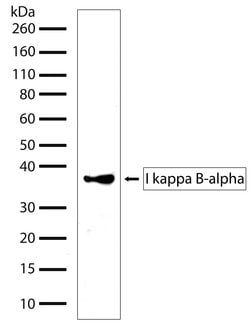
- IkB-alpha is a 40 kDa protein that functions to inhibit NF- kappaB activity
- The inhibition occurs via protein-protein interaction between I kappaB proteins and NF- kappaB dimers in the cytosol
- The interaction of I kappa B-alpha with NF- kappaB masks the nuclear localization sequence of NF- kappaB, preventing NF- kappaB translocation to the nucleus
- A variety of stimuli can activate gene expression by liberating NF- kappaB through the degradation of I kappaB alpha
- These stimuli include the proinflammatory cytokines TNF- alpha and IL-1 beta, chemokines, PMA, growth factors, LPS, UV irradiation, viral infection, as well as various chemical and physical stresses
- In humans, the gene is located on the q arm of chromosome 14
- Activation of NFkB requires that IkB be phosphorylated on specific serine residues, which results in targeted degradation of IkB
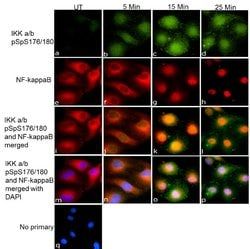
- IkB kinase alpha (IKK alpha), previously designated CHUK, interacts with IkB-alpha and specifically phosphorylates IkB-alpha on the sites that trigger its degradation Serines 32 and 36
- IKK alpha appears to be critical for NFkB activation in response to proinflammatory cytokines
- Phosphorylation of IkB by IKK alpha is stimulated by the NFkB inducing kinase (NIK), which itself is a central regulator for NFkB activation in response to TNF and IL-1
- The functional IKK complex contains three subunits, IKK alpha, IKK beta and IKK gamma, and each appear to make essential contributions to IkB phosphorylation.