FGFR3 Monoclonal Antibody (T.994.9), Invitrogen™
Manufacturer: Thermo Scientific
Select a Size
| Pack Size | SKU | Availability | Price |
|---|---|---|---|
| Each of 1 | PIMA514843-Each-of-1 | In Stock | ₹ 46,947.50 |
PIMA514843 - Each of 1
In Stock
Quantity
1
Base Price: ₹ 46,947.50
GST (18%): ₹ 8,450.55
Total Price: ₹ 55,398.05
Antigen
FGFR3
Classification
Monoclonal
Concentration
27 μg/mL
Formulation
0.01M HEPES with 0.15M NaCl, 100μg/mL BSA, 50% glycerol and <0.02% sodium azide; pH 7.5
Gene Accession No.
P22607
Gene Symbols
FGFR3
Immunogen
GST-FGFR-3 cytoplasmic domain fusion protein
Quantity
100 μL
Primary or Secondary
Primary
Target Species
Human
Product Type
Antibody
Isotype
IgG
Applications
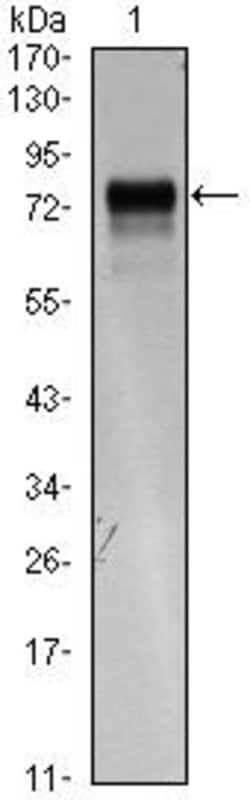
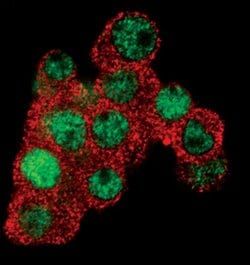
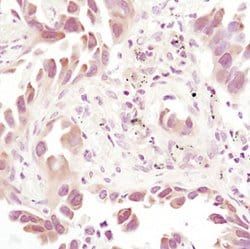
Immunocytochemistry, Immunohistochemistry (Paraffin), Immunoprecipitation, Western Blot
Clone
T.994.9
Conjugate
Unconjugated
Gene
FGFR3
Gene Alias
ACH; CD333; CEK2; FGFR3; FGFR-3; FGFR3deltaTM; Fibroblast growth factor receptor 3; fibroblast growth factor receptor 3 variant 4; Flg-2; FR3; HBGFR; heparin-binding growth factor receptor; HSFGFR3EX; hydroxyaryl-protein kinase; JTK4; Mfr3; sam3; tyrosine kinase JTK4
Host Species
Rabbit
Purification Method
Affinity chromatography
Regulatory Status
RUO
Gene ID (Entrez)
2261
Content And Storage
-20°C
Form
Liquid
Related Products
Description
- It is not recommended to aliquot this antibody
- This antibody is not cross-reactive with other related family members
- FGFR3 is a member of the FGFR family of receptor tyrosine kinases
- This family is known to regulate a host of cellular functions including angiogenesis, mitogenesis, osteogenesis, myogenesis, carcinogenesis, cellular differentiation, and tissue repair after injury
- The FGFR family has also been implicated in a number of diseases including cancer, rheumatoid arthritis, and diabetic retinopathy
- FGFR family members differ from one another in their ligand affinities and tissue distribution
- A full-length representative protein would consist of an extracellular region, composed of three immunoglobulin-like domains, a single hydrophobic membrane-spanning segment and a cytoplasmic tyrosine kinase domain
- The extracellular portion of the protein interacts with fibroblast growth factors, setting in motion a cascade of downstream signals, μgtimately influencing mitogenesis and differentiation
- This particular family member binds acidic and basic fibroblast growth hormone and plays a role in bone development and maintenance
- Mutations in this gene lead to craniosynostosis and multiple types of skeletal dysplasia
- Three alternatively spliced transcript variants that encode different protein isoforms have been described.