PIMA516698
CD42a Monoclonal Antibody (GRP-P), PE, Invitrogen™
Manufacturer: Thermo Scientific
Select a Size
| Pack Size | SKU | Availability | Price |
|---|---|---|---|
| Each of 1 | PIMA516698-Each-of-1 | In Stock | ₹ 43,743.50 |
PIMA516698 - Each of 1
In Stock
Quantity
1
Base Price: ₹ 43,743.50
GST (18%): ₹ 7,873.83
Total Price: ₹ 51,617.33
Antigen
CD42a
Classification
Monoclonal
Concentration
Conc. Not Determined
Formulation
PBS with 1% BSA, 5% sucrose and 0.09% sodium azide
Gene Accession No.
P14770
Gene Symbols
GP9
Immunogen
Human red blood cells and platelets
Quantity
100 Tests
Primary or Secondary
Primary
Target Species
Human, Mink
Product Type
Antibody
Isotype
IgG1
Applications
Flow Cytometry
Clone
GRP-P
Conjugate
PE
Gene
GP9
Gene Alias
CD42a; Glycoprotein 9; glycoprotein 9 (platelet); glycoprotein IX (platelet); glycoprotein IX platelet; GP9; GPIX; GP-IX; platelet glycoprotein IX; Platelet GPIX
Host Species
Mouse
Purification Method
Protein A
Regulatory Status
RUO
Gene ID (Entrez)
2815
Content And Storage
4° C, store in dark, DO NOT FREEZE!
Form
Lyophilized
Related Products

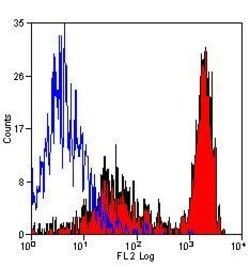
Description
- Reconstitute with 1 mL of distilled water
- After reconstitution, store product undiluted at 4oC in the dark
- For FACS analysis, use 10 μL of the suggested working dilution to label 1x10^6 cells in 100 μL
- Single-chain membrane glycoprotein that forms a non-covalent complex with GPIb
- (MW 23 kDa) Reactivity with resting and activated platelets, weakly on monocytes, megakaryocytes and attachment site for the platelet plasma membrane to the submembrane cytoskeleton
- GPIb/IX complex, functions as the receptor for ristocetin-induced binding of von Willebrand factor and as the von Willebrand factor-depend adhesion receptor.