HMGB1 Monoclonal Antibody (GT383), Invitrogen™
Manufacturer: Thermo Scientific
Select a Size
| Pack Size | SKU | Availability | Price |
|---|---|---|---|
| Each of 1 | PIMA517277-Each-of-1 | In Stock | ₹ 53,667.00 |
PIMA517277 - Each of 1
In Stock
Quantity
1
Base Price: ₹ 53,667.00
GST (18%): ₹ 9,660.06
Total Price: ₹ 63,327.06
Antigen
HMGB1
Classification
Monoclonal
Concentration
0.73 mg/mL
Formulation
PBS with no preservative
Gene Accession No.
P09429, P63158, P63159
Gene Symbols
Hmgb1
Immunogen
Recombinant fragment contains a sequence corresponding to a region within amino acids 2 and 159 of HMGB1
Quantity
100 μL
Primary or Secondary
Primary
Target Species
Human, Mouse, Rat
Product Type
Antibody
Isotype
IgG2b
Applications
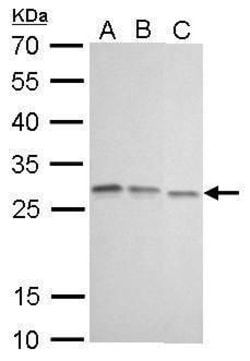
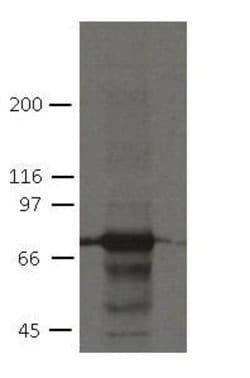
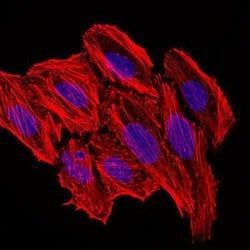
Immunocytochemistry, Immunohistochemistry (Frozen), Immunohistochemistry (Paraffin), Western Blot
Clone
GT383
Conjugate
Unconjugated
Gene
Hmgb1
Gene Alias
Ac2-008; amphoterin; Amphoterin antibody; DEF; DKFZp686A04236; Heparin-binding protein p30; high mobility group 1; high mobility group 1 protein; high mobility group box 1; high mobility group protein 1; High mobility group protein B1; high mobility group protein HMG1; high-mobility group (nonhistone chromosomal) protein 1; high-mobility group box 1; high-mobility-group protein; Hmg1; HMG-1; HMG3; HMG3 antibody; hmgb 1; HMGB1; hmgb-1; HMGB1 protein; hypothetical protein; non-histone protein HMG1; p30; RCJMB04_15a21; RP11-550P23.1; SBP-1; Sulfoglucuronyl carbohydrate binding protein; unnamed protein product
Host Species
Mouse
Purification Method
Protein G
Regulatory Status
RUO
Gene ID (Entrez)
15289, 25459, 3146
Content And Storage
Store at 4°C short term. For long term storage, store at -20°C, avoiding freeze/thaw cycles.
Form
Liquid
Related Products


Description
- Recommended positive controls: 293T, A431, HeLa, HepG2, A375, Neuro2A, C8D30, NIH-3T3, BCL-1, Raw264.7, C2C12, PC-12, Rat2, mouse brain, rat brain
- Predicted reactivity: Mouse (100%), Rat (100%), Xenopus laevis (93%), Dog (100%), Pig (100%), Rabbit (100%), Chicken (94%), Rhesus Monkey (100%), Bovine (100%)
- Store product as a concentrated solution
- Centrifuge briefly prior to opening the vial
- HMGB1 (High-mobility group box-1) protein was originally described as a nuclear non-histone DNA binding chromosomal protein
- However, recent studies indicate that damaged, necrotic cells liberate HMGB1 into the extracellular milieu where it functions as a proinflammatory cytokine
- Mouse HMGB1 is expressed as a 215 amino acid single chain polypeptide containing three domains: two tandem-linked positively charged DNA-binding domains (HMG box A, aa 9-79; and box B, aa 89-162), and a negatively charged 30 aa C-terminal acidic tail region
- Residues 28 - 44 and 180 - 185 contain a nuclear localization signal (NLS)
- The cytokine activity of HMGB1 is contained in the B box, while the A box is associated with the helix-loop-helix domain of transcription factors
- HMGB1 acts both as an inflammatory mediator that promotes monocyte migration and cytokine secretion, as well as a mediator of T cell-dendritic cell interaction
- HMGB1 is secreted and acts to transduce cellular signals through its high affinity receptor, RAGE and possibly, TLR2 and TLR4
- HMGB1 is highly conserved and ubiquitous in the nuclei and cytoplasm of nearly all cell types, is a necessary and sufficient mediator of inflammation during sterile and infection-associated responses
- HMGB1 also act as DNA nuclear binding protein that has recently been shown to be an early trigger of sterile inflammation in animal models of trauma-hemorrhage via the activation of the Toll-like receptor 4 (TLR4) and the receptor for the advanced glycation endproducts (RAGE)
- Moreover, HMGB1 is reported that the level of HMGB1 is elevated during sterile tissue injury, infection, lethal endotoxemia or sepsis, collagen-induced arthritis, and ischemia-reperfusion induced tissue injury.