PKP1 Monoclonal Antibody (19F10), Invitrogen™
Manufacturer: Thermo Scientific
Select a Size
| Pack Size | SKU | Availability | Price |
|---|---|---|---|
| Each of 1 | PIMA518082-Each-of-1 | In Stock | ₹ 49,884.50 |
PIMA518082 - Each of 1
In Stock
Quantity
1
Base Price: ₹ 49,884.50
GST (18%): ₹ 8,979.21
Total Price: ₹ 58,863.71
Antigen
PKP1
Classification
Monoclonal
Concentration
1 mg/mL
Formulation
PBS with 0.1% sodium azide
Gene Accession No.
P97350, Q13835
Gene Symbols
PKP1
Immunogen
Recombinant fragment, corresponding to amino acids 235-726 of Human Plakophilin 1 fused to maltose binding protein
Quantity
100 μL
Primary or Secondary
Primary
Target Species
Human, Mouse
Product Type
Antibody
Isotype
IgG1
Applications
Immunohistochemistry (Frozen), Immunohistochemistry (Paraffin), Immunoprecipitation, Western Blot
Clone
19F10
Conjugate
Unconjugated
Gene
PKP1
Gene Alias
AI528551; armadillo; B6P; band 6; band 6 polypeptide B6P; band 6 protein; Band-6 protein; MGC138829; Pkp1; plakophilin; plakophilin 1; plakophilin 1 (ectodermal dysplasia/skin fragility syndrome); plakophilin-1
Host Species
Mouse
Purification Method
Protein A
Regulatory Status
RUO
Gene ID (Entrez)
18772, 5317
Content And Storage
Store at 4°C short term. For long term storage, store at -20°C, avoiding freeze/thaw cycles.
Form
Liquid
Related Products





Description
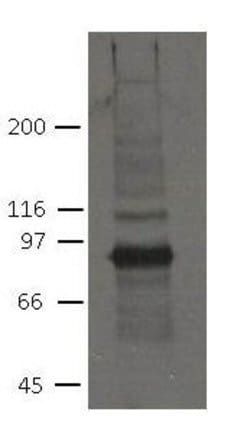
- This target has a predicted molecular weight of 81 kDa
- This gene encodes a member of the arm-repeat (armadillo) and plakophilin gene families
- Plakophilin proteins contain numerous armadillo repeats, localize to cell desmosomes and nuclei, and participate in linking cadherins to intermediate filaments in the cytoskeleton
- This protein may be involved in molecular recruitment and stabilization during desmosome formation
- Mutations in this gene have been associated with the ectodermal dysplasia/skin fragility syndrome
- Two transcript variants encoding different isoforms have been found for this gene
- [provided by RefSeq, Jul 2010].