I-Ab Monoclonal Antibody (25-5-16S), Biotin, Invitrogen™
Manufacturer: Thermo Scientific
Select a Size
| Pack Size | SKU | Availability | Price |
|---|---|---|---|
| Each of 1 | PIMA517759-Each-of-1 | In Stock | ₹ 25,587.50 |
PIMA517759 - Each of 1
In Stock
Quantity
1
Base Price: ₹ 25,587.50
GST (18%): ₹ 4,605.75
Total Price: ₹ 30,193.25
Antigen
I-Ab
Classification
Monoclonal
Concentration
0.1 mg/mL
Formulation
PBS with 4-5mg/mL BSA and 0.1% sodium azide
Gene Accession No.
P01921, P06342, P06343, P06344, P06345, P06346, P14483
Gene Symbols
H2-Ab1
Immunogen
Mouse I-Ab
Quantity
100 μg
Primary or Secondary
Primary
Target Species
Mouse
Product Type
Antibody
Isotype
IgM
Applications
Flow Cytometry
Clone
25-5-16S
Conjugate
Biotin
Gene
H2-Ab1
Gene Alias
Abeta; AI845868; CELIAC1; DADB-249P12.2; H-2 class II histocompatibility antigen, A beta chain; H-2Ab; H2-Ab; H2-Ab1; H2Eb; H-2Eb; H2-iabeta; histocompatibility 2, class II antigen A, beta 1; HLA-DQB; Ia2; Ia-2; Ia4; Ia-4; IAb; I-Abeta; IDDM1; major histocompatibility complex class II beta chain; MGC163794; MGC163796; MHC class II antigen A beta; MHC class II H2-IA-beta-psi; response to metastatic cancers 1; Rmcs1
Host Species
Mouse
Purification Method
Protein G
Regulatory Status
RUO
Gene ID (Entrez)
14961
Content And Storage
Store at 4°C short term. For long term storage, store at -20°C, avoiding freeze/thaw cycles.
Form
Liquid
Related Products

Description
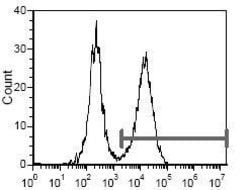
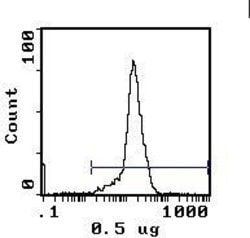
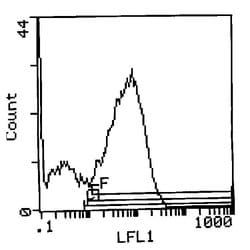
- MA5-17759 targets I-Ab in FACS applications and shows reactivity with Mouse samples
- The MA5-17759 immunogen is mouse I-Ab
- I-Ab (H2-Ab1, histocompatibility 2, class II antigen A, beta 1) is an MHC class II heterodimer molecule of non-covalently associated alpha (31-34 kDa) and beta (26-29 kDa) chains
- Major histocompatibility complex class II antigen presentation requires the participation of lysosomal proteases in two convergent processes
- First, the antigens endocytosed by the antigen presenting cells must be broken down into antigenic peptides
- Second, class II molecules are synthesized with their peptide-binding site blocked by invariant chain (Ii), and they aquire the capacity to bind antigens only after Ii has been degraded in the compartments where peptides reside
- MHC class II molecules present exogenously derived antigen to CD4+ T lymphocytes, which are usually T helper cells
- CD4 interacts with non-polymorphic residues of MHC class II
- H2-Ab1 heterodimer chains alpha (DQA) and beta (DQB) are both anchored in the membrane
- H2-Ab1 plays a central role in the immune system by presenting peptides derived from extracellular proteins
- Class II molecules are expressed in antigen presenting cells (APC: B lymphocytes, dendritic cells, macrophages)
- The beta chain contains 6 exons
- Exon one encodes the leader peptide, exons 2 and 3 encode the two extracellular domains, exon 4 encodes the transmembrane domain and exon 5 encodes the cytoplasmic tail
- Within the DQ molecule both the alpha chain and the beta chain contain the polymorphisms specifying the peptide binding specificities, resulting in up to 4 different molecules
- Typing for polymorphisms is routinely done for bone marrow transplantation
- HLA and MHC antibodies play a significant role in Immunopeptidomics, facilitating the identification and characterization of neoantigens through high-performance liquid chromatography coupled to tandem Mass Spectrometry.