PIMA524432
RGN Monoclonal Antibody (4B9), Invitrogen™
Manufacturer: Thermo Scientific
Select a Size
| Pack Size | SKU | Availability | Price |
|---|---|---|---|
| Each of 1 | PIMA524432-Each-of-1 | In Stock | ₹ 47,748.50 |
PIMA524432 - Each of 1
In Stock
Quantity
1
Base Price: ₹ 47,748.50
GST (18%): ₹ 8,594.73
Total Price: ₹ 56,343.23
Antigen
RGN
Classification
Monoclonal
Concentration
0.4 mg/mL
Formulation
PBS with no preservative; pH 7.4
Gene Accession No.
Q15493
Gene Symbols
Rgn
Immunogen
RGN (NP_004674.1, 200 a.a. ∽ 299 a.a) partial recombinant protein with GST tag. MW of the GST tag alone is 26 KDa.
Quantity
100 μg
Primary or Secondary
Primary
Target Species
Human
Product Type
Antibody
Isotype
IgG2a κ
Applications
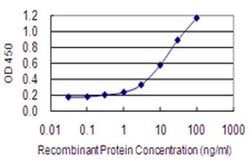
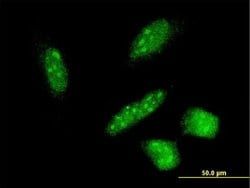
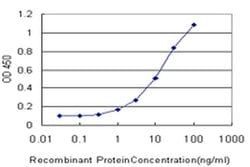
ELISA, Immunocytochemistry, Western Blot
Clone
4B9
Conjugate
Unconjugated
Gene
Rgn
Gene Alias
AI265316; epididymis secretory protein Li 41; gluconolactonase; GNL; HEL-S-41; RC; Reguc; regucalcin; regucalcin (senescence marker protein-30); Rgn; Senescence marker protein 30; Smp30; SMP-30
Host Species
Mouse
Purification Method
Protein A
Regulatory Status
RUO
Gene ID (Entrez)
9104
Content And Storage
-20° C, Avoid Freeze/Thaw Cycles
Form
Liquid
Related Products

Description
- Peptide Sequence: EQIPDGMCID AEGKLWVACY NGGRVIRLDP VTGKRLQTVK LPVDKTTSCC FGGKNYSEMY VTCARDGMDP EGLLRQPEAG GIFKITGLGV KGIAPYSYAG The protein encoded by this gene is a highly conserved, calcium-binding protein, that is preferentially expressed in the liver and kidney
- It may have an important role in calcium homeostasis
- Studies in rat indicate that this protein may also play a role in aging, as it shows age-associated down-regulation
- This gene is part of a gene cluster on chromosome Xp11.3-Xp11.23
- Alternative splicing results in two transcript variants having different 5' UTRs, but encoding the same protein.