RABL2A Monoclonal Antibody (OTI5A10), Invitrogen™
Manufacturer: Thermo Scientific
Select a Size
| Pack Size | SKU | Availability | Price |
|---|---|---|---|
| Each of 1 | PIMA525315-Each-of-1 | In Stock | ₹ 52,198.50 |
PIMA525315 - Each of 1
In Stock
Quantity
1
Base Price: ₹ 52,198.50
GST (18%): ₹ 9,395.73
Total Price: ₹ 61,594.23
Antigen
RABL2A
Classification
Monoclonal
Concentration
0.78 mg/mL
Formulation
PBS with 1% BSA, 50% glycerol and 0.02% sodium azide; pH 7.3
Gene Accession No.
Q9UBK7
Gene Symbols
RABL2A
Immunogen
Full length human recombinant protein of RABL2A produced in HEK293T cell
Quantity
100μL
Primary or Secondary
Primary
Target Species
Human
Product Type
Antibody
Isotype
IgG1
Applications
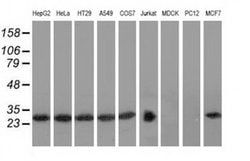
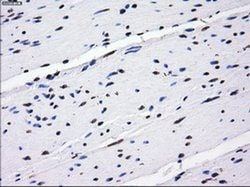
Immunohistochemistry (Paraffin), Western Blot
Clone
OTI5A10
Conjugate
Unconjugated
Gene
RABL2A
Gene Alias
1110031N17Rik; AW549303; RAB, member of RAS oncogene family-like 2; RAB, member of RAS oncogene family-like 2A; RAB, member of RAS oncogene family-like 2B; RAB, member RAS oncogene family-like 2; Rabl2; RABL2A; Rabl2b; rab-like protein 2A; rab-like protein 2B; RP11-395L14.2
Host Species
Mouse
Purification Method
Affinity Chromatography
Regulatory Status
RUO
Gene ID (Entrez)
11159
Content And Storage
-20° C, Avoid Freeze/Thaw Cycles
Form
Liquid
Related Products




Description
- This gene is a member of the RAB gene family which belongs to the RAS GTPase superfamily
- The proteins in the family of RAS-related signaling molecules are small GTP-binding proteins that play important roles in the regulation of exocytotic and endocytotic pathways
- This gene maps to the site of an ancestral telomere fusion event and may be a subtelomeric gene
- Alternative splicing results in multiple transcript variants encoding different isoforms.