TXNL2 Monoclonal Antibody (OTI2F2), Invitrogen™
Manufacturer: Thermo Scientific
Select a Size
| Pack Size | SKU | Availability | Price |
|---|---|---|---|
| Each of 1 | PIMA527392-Each-of-1 | In Stock | ₹ 52,198.50 |
PIMA527392 - Each of 1
In Stock
Quantity
1
Base Price: ₹ 52,198.50
GST (18%): ₹ 9,395.73
Total Price: ₹ 61,594.23
Antigen
TXNL2
Classification
Monoclonal
Concentration
1 mg/mL
Formulation
PBS with 1% BSA, 50% glycerol and 0.02% sodium azide; pH 7.3
Gene Accession No.
O76003
Gene Symbols
GLRX3
Immunogen
Full length human recombinant protein of GLRX3 produced in HEK293T cell
Quantity
100μL
Primary or Secondary
Primary
Target Species
Human
Product Type
Antibody
Isotype
IgG2a
Applications
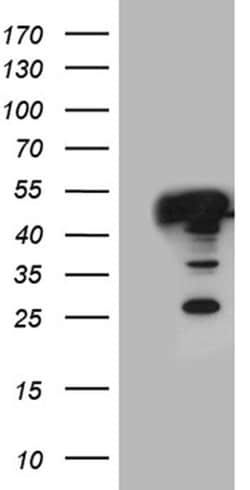
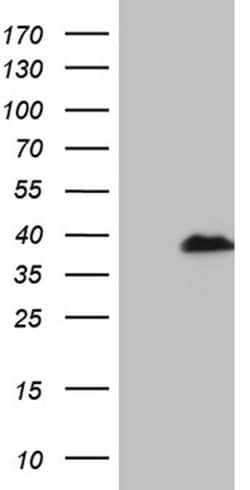
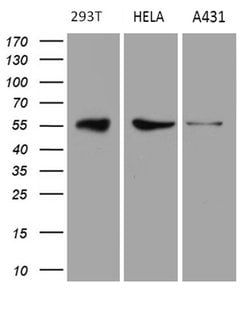
Western Blot
Clone
OTI2F2
Conjugate
Unconjugated
Gene
GLRX3
Gene Alias
bA500G10.4; FLJ11864; Glrx3; GLRX4; glutaredoxin 3; glutaredoxin 4; glutaredoxin-3; GRX3; GRX4; HUSSY-22; Picot; PKC interacting cousin of thioredoxin; PKC-interacting cousin of thioredoxin; PKCq-interacting protein; PKC-theta-interacting protein; testicular tissue protein Li 75; thioredoxin-like 2; thioredoxin-like protein 2; TXNL2; TXNL3
Host Species
Mouse
Purification Method
Affinity Chromatography
Regulatory Status
RUO
Gene ID (Entrez)
10539
Content And Storage
-20° C, Avoid Freeze/Thaw Cycles
Form
Liquid
Related Products
Description
- This gene encodes a member of the glutaredoxin family
- Glutaredoxins are oxidoreductase enzymes that reduce a variety of substrates using glutathione as a cofactor
- The encoded protein binds to and modulates the function of protein kinase C theta
- The encoded protein may also inhibit apoptosis and play a role in cellular growth, and the expression of this gene may be a marker for cancer
- Pseudogenes of this gene are located on the short arm of chromosomes 6 and 9
- Alternatively spliced transcript variants have been observed for this gene.