BIN1 Monoclonal Antibody (3B6A4), Invitrogen™
Manufacturer: Thermo Scientific
Select a Size
| Pack Size | SKU | Availability | Price |
|---|---|---|---|
| Each of 1 | PIMA531651-Each-of-1 | In Stock | ₹ 49,350.50 |
PIMA531651 - Each of 1
In Stock
Quantity
1
Base Price: ₹ 49,350.50
GST (18%): ₹ 8,883.09
Total Price: ₹ 58,233.59
Antigen
BIN1
Classification
Monoclonal
Concentration
1 mg/mL
Formulation
PBS with 0.05% sodium azide
Gene Accession No.
O00499, O08539
Gene Symbols
BIN1
Immunogen
Purified recombinant fragment of human BIN1 (AA: 189-398) expressed in E. coli.
Quantity
100 μL
Primary or Secondary
Primary
Target Species
Human, Mouse
Product Type
Antibody
Isotype
IgG2b
Applications
ELISA, Flow Cytometry, Western Blot
Clone
3B6A4
Conjugate
Unconjugated
Gene
BIN1
Gene Alias
ALP-1; AMPH 2; Amph2; amphiphysin 2; amphiphysin II; amphiphysin IIamph2; amphiphysin-like; amphiphysin-like protein; AMPHL; Bin1; box dependant MYC interacting protein 1; box-dependent myc-interacting protein 1; BRAMP-2; bridging integrator 1; DKFZp547F068; MGC10367; MGC105358; myc box dependent interacting protein 1; myc box-dependent-interacting protein 1; SH3 domain-containing protein 9; SH3P9; similar to bridging integrator 1 isoform 9
Host Species
Mouse
Purification Method
Protein G
Regulatory Status
RUO
Gene ID (Entrez)
274, 30948
Content And Storage
Store at 4°C short term. For long term storage, store at -20°C, avoiding freeze/thaw cycles.
Form
Liquid
Related Products




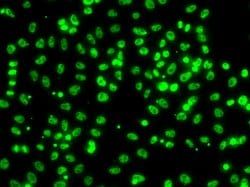
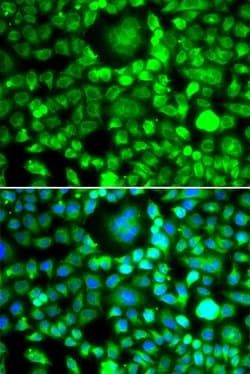


Description
- MA5-31651 has been tested in indirect ELISA
- This gene encodes several isoforms of a nucleocytoplasmic adaptor protein, one of which was initially identified as a MYC-interacting protein with features of a tumor suppressor
- Isoforms that are expressed in the central nervous system may be involved in synaptic vesicle endocytosis and may interact with dynamin, synaptojanin, endophilin, and clathrin
- Isoforms that are expressed in muscle and ubiquitously expressed isoforms localize to the cytoplasm and nucleus and activate a caspase-independent apoptotic process
- Studies in mouse suggest that this gene plays an important role in cardiac muscle development
- Alternate splicing of the gene results in ten transcript variants encoding different isoforms
- Aberrant splice variants expressed in tumor cell lines have also been described.